
Tennis Tips UK · Research & reports
The giant-killer effect in tennis: back a player after beating a champion?
Published October 16, 2026
Should you back a giant-killer in their next match—or oppose them? A shock win against a major champion can attract attention and move expectations. Yet the important question is not whether the upset was impressive; it is whether the next match is priced fairly, after accounting for the new opponent, surface, workload and uncertainty.
Research verdict: Published descriptive studies show a surprisingly high rate of next-round losses among players who had just beaten big names. One independent odds-based backtest also found poor returns from blindly following them. Neither result is a verified, forward-tested system you can simply copy. The market price, comparison group and timing decide whether any betting edge exists.
What exactly is the giant-killer strategy?
A “giant-killer” is a player who defeats a far more highly regarded opponent—often a Grand Slam winner or a top-ten star. The proposed back-the-winner strategy assumes that excellent recent play and confidence carry into the following round. The proposed fade-the-winner strategy assumes the market overreacts to that result, or that exertion and pressure make a repeat performance less likely.
These are competing hypotheses. A big-name upset does not tell us who will win next without knowing the standard of the next opponent. An underdog can defeat a favourite and still be the correct underdog the following day.
What the reported next-round results actually show
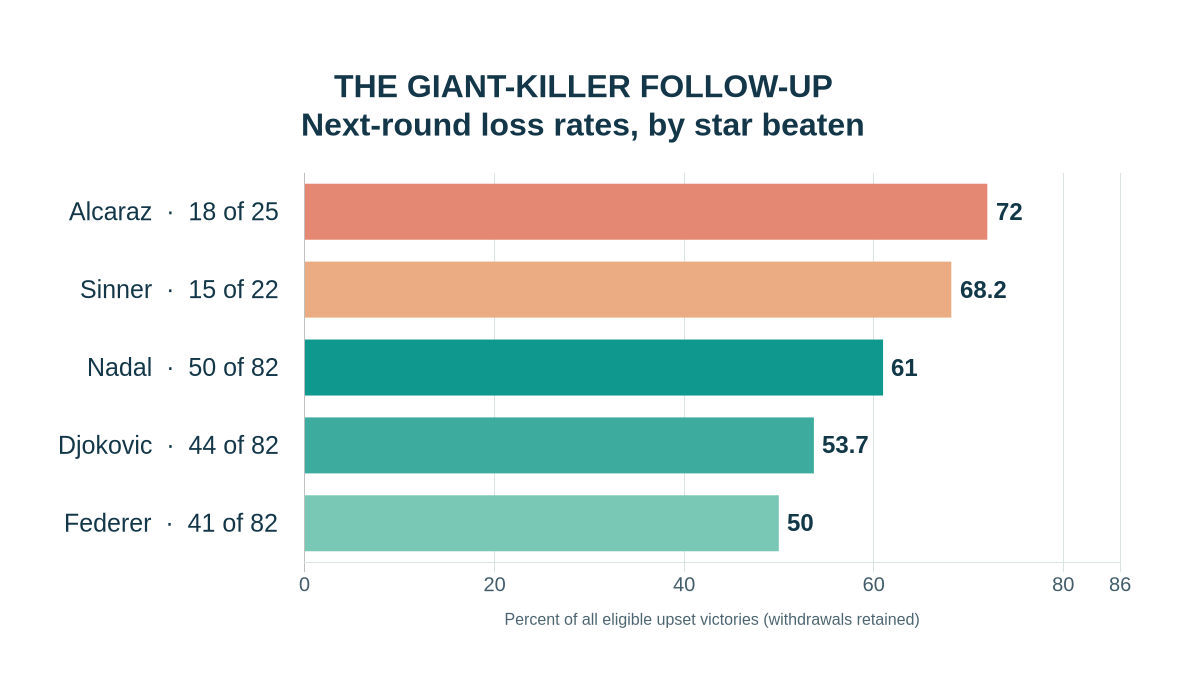
| Champion beaten | Qualifying upsets | Next-round losses | Did not play |
|---|---|---|---|
| Carlos Alcaraz | 25 | 18 (72%) | 0 |
| Jannik Sinner | 22 | 15 (68.2%) | 1 |
| Rafael Nadal | 82 | 50 (61.0%) | 2 |
| Novak Djokovic | 82 | 44 (53.7%) | 2 |
| Roger Federer | 82 | 41 (50.0%) | 2 |
| Total | 293 | 168 | 7 |
Of the 293 qualifying upsets, the next result was a loss in 168 cases, a win in 118, and an unplayed next match in seven. Thus 168/293 = 57.3% of all recorded qualifying upsets were followed by defeat; if we exclude the seven unplayed matches, 168/286 = 58.7% of played follow-up matches ended in defeat. The choice of denominator matters.
This sample is not a random set of tennis matches. The defeated stars are exceptional, eligibility depends on both players’ rankings, events without another round are omitted and different players face different follow-up opponents. A 58.7% loss share alone cannot show that a bookmaker has mispriced those matches.
Does betting against a giant-killer make money?
In a separate independent Tennis Edge analysis, the author examined 250 same-tournament follow-up matches from 2010 to 24 March 2026 after victories against Federer, Nadal, Djokovic, Alcaraz and Sinner, using a different “giant” eligibility rule: the younger players were included after winning their first Slam. The author reports −21.6% flat-stake return backing the giant-killer and +7.4% opposing them at Pinnacle closing odds.
Those figures are the author’s reported backtest, not Tennis Tips UK’s results, nor a calculation independently replicated by our team. Crucially, the author does not regard the +4.6% opposition return as statistically secure, and notes much of the favourable period was concentrated in 2010–2017. This warns against mistaking one retrospective profit figure for a robust, currently available advantage.
Do not combine the 293-outcome table above with the 250-bet profit study into a single dataset: the eligibility windows, definitions and methods differ. And do not assume old closing odds were obtainable to a follower on the day.
Four plausible explanations—and which are proven?
1. Attention and narrative-driven repricing
Television, headlines and social conversation can make the breakthrough win salient. A plausible hypothesis is that some bettors respond more strongly to a high-profile upset than to the next opponent’s underlying probability. Testing it needs pre- and post-upset market prices and a comparison with similarly rated winners. The historical loss counts alone do not establish an overreaction.
2. Fatigue and schedule
An upset may involve long rallies, prolonged pressure or less recovery time. A peer-reviewed 2014 review of tennis match-play fatigue found measurable physiological and subjective responses across repeated days of play, but warned that direct causal evidence connecting fatigue to subsequent match outcomes was limited. Match length, rest, weather and injury information are more meaningful than an automatic “emotional hangover” label.
3. Genuine form, tactics and momentum
The opponent may have won because a durable improvement was already emerging: better serve points, a healthy return after injury or a matchup advantage. Research on tennis point-to-point momentum, such as Gauriot and Page’s 2019 work, considers effects within matches; it does not show that beating a champion creates a profitable next-round pre-match bet.
4. Selection and opponent strength
The giant-killer’s next opponent is often still a strong professional. Matches are conditional on surviving to the next round, and finals provide no next match. Before assigning causality, estimate the result expected from player ratings and the actual next opponent. If the player was a 40% chance to win, losing 60% of the time is unremarkable.
The same predicted chance can give opposite betting decisions
Illustrative calculation, not real market odds: assume you estimate the next-round chance of a giant-killer at 52% after considering both players and the conditions. At decimal odds 1.80, expected net return per £1 is 0.52 × 1.80 − 1 = −6.4%. At odds 1.95 it is 0.52 × 1.95 − 1 = +1.4%, before commissions or other costs. Both bets have the same match probability; the price flips the theoretical sign. The 52% estimate itself may be wrong, which can eliminate the apparent edge.
In other words, “back” or “fade” is not the test. The relevant comparison is a calibrated match probability against a real, attainable price with costs included.
How we would test a giant-killer claim properly
- Pre-register the definition: top-ten upset, Slam-winner upset or fixed Elo difference; choose one rather than whichever looks most profitable later.
- Define exposure precisely: same-tournament following round, pre-match singles only, with rules for withdrawals, walkovers and finals.
- Construct a fair baseline: compare with similarly priced winners who did not defeat a giant, adjusting for surface, round and next opponent strength.
- Time-stamp prices: record opening, decision-time, obtainable follower and closing odds, with commission and margin treatment made explicit.
- Test recent holdouts: evaluate years, ATP versus WTA, surfaces and tournament level separately; show intervals, drawdown and how many bets actually qualify.
- Guard against publication bias: a compelling retrospective angle can be one of hundreds examined. A new and untouched sample matters more than an eye-catching in-sample return.
Verdict: investigate the price, not the headline
A player who has just beaten a champion has demonstrated something worth examining—but not automatically a new sustainable level, nor automatic vulnerability next round. The published studies make the “giant-killer hangover” a reasonable research question, not a universal next-match betting instruction. If the available price already reflects the upset, there is no reason to follow either side mechanically.
This also connects with our earlier research on opposing tournament winners in their next event: both ideas involve a high-salience win, but the exposure periods and types of opponent differ, so results must not be merged. For a wider framework, read our closing-line-value analysis and the club’s complete public record.
Sources, provenance and limitations
- Punto de Break (15 October 2026), “The Curse of the Champions.” Published aggregate counts. Our graphic is a new visualisation of those reported counts. Not independent reanalysis of raw match files.
- Tennis Edge (24 March 2026), “The Giant Killer Effect.” Separate 250-match Pinnacle-closing-odds backtest, reported −21.6% backing and +7.4% fading, with stated lack of significance for the latter.
- Reid and Duffield (2014), “The development of fatigue during match-play tennis.” Peer-reviewed review; physiological load is documented, specific next-round causation is not established.
- Royal Economic Society (2019), “Economics of hot hand: evidence from tennis.” Momentum at point level; not a next-match betting return study.
Scope: Educational discussion of published external studies and clearly labelled hypothetical arithmetic. We did not reconstruct the raw 293-match or 258-bet datasets, and we do not claim any currently profitable system. Results depend on definitions, sample period, available price, limits and settlement. Betting carries loss risk. For adults only where legal.
From research to informed decisions
Want to see how we select actual tennis picks?
We publish the full historical record, including losses and drawdowns. Club membership delivers around two pre-match selections per week by email. Review the price, terms and risks before deciding whether it suits you.
View paid club membership →Verify complete results →
Not considering a membership? Subscribe to free public-result updates (email confirmation required). For an independent evaluation, the free tipster-evaluation worksheet requires no email.
Share or cite this original review: Tennis Tips UK (16 October 2026), https://tennis-tips.co.uk/tennis_betting_research_articles/2026/10/16/tennis-giant-killer-next-match-betting-research/. External data sources are credited in the article. Sharing does not imply an endorsement or profitable strategy.
See the wider picture.
Read the research alongside the complete results record. See every win and loss and how our proprietary data model and human review select picks.
To interpret prices alongside outcomes, read our research on closing line value. It explains what a market benchmark can show and where it can mislead.
Payment & membership details
Credit and debit cards are accepted through Stripe. PayPal, Apple Pay and Link are also offered where available. Stripe displays the payment options available for your device and country at checkout.
£49.99/month is the base membership price. Stripe may show a local-currency price; check the first payment and renewal amount before subscribing.
All picks and member emails are delivered in English. International members are welcome where betting is legal.
You manage your membership through Stripe and can cancel whenever you choose, without contacting us for approval. Cancellation and refunds are separate.
Member reviews: TipsterCheck ↗ Trustpilot ↗
Maximum 50 paid members. No bookmaker affiliate links. Historical results are before fees and do not guarantee future returns.
Explore tennis betting value and profitability, units and bankroll management, or the tennis picks and results archive.
Follow the record first
Free public result updates.
Follow new public bet reports by email, with their recorded results and occasional membership invitations. Paid pre-match picks are a separate service.
Confirmation required. Unsubscribe at any time. Privacy policy.