
Tennis Tips UK · Research & reports
Closing line value in tennis: useful benchmark or false certainty?
Published October 13, 2026
Tennis betting research · Methodology reviewed 13 October 2026
Closing line value asks whether the price you accepted was better than the market’s final pre-match price. It is useful evidence about execution and market agreement. It is not a guarantee of profit, a measurement of a player’s health, or an infallible estimate of the true chance of winning.
This article separates raw price movement, a margin-adjusted closing benchmark and actual net results. It also examines the tennis-specific disagreement about CLV raised by Nishikori Picks and Joseph Buchdahl’s market-efficiency research.
What should closing line value measure?
For a back bet on the same player in the same match-winner market, a larger decimal price pays more if that player wins. A simple raw measure is bet odds ÷ closing odds − 1. Taking 2.10 before a close of 2.00 produces +5% on this definition. This describes a price improvement; it does not establish that either quoted price is fair.
Definitions matter. Some records use a change in implied probability, others a percentage odds ratio, and others expected return against a margin-free close. They are related but not interchangeable. A report should identify its formula and its reference bookmaker or exchange. A result of “+5% CLV” without those details cannot be compared reliably with another record.
The market must also match. Comparing a standard moneyline bet with a set handicap, a different retirement rule or a price quoted after play began introduces a different contract. A suspended or stale quote is not a usable close. The close should be a defined final pre-start observation, with a timestamp and both sides of the market retained.
A worked example: remove the margin first
Suppose you accept 2.10 on Player A. Immediately before the match, both players are offered at 1.91. Each raw implied probability is 1/1.91 = 52.36%, so the two outcomes add to 104.71%. That total exceeds 100% because the quotes include a margin.
With a simple proportional removal, each fair benchmark probability is 52.36% ÷ 104.71% = 50%, corresponding to decimal odds 2.00. Your raw odds movement is 2.10/1.91 − 1 = +9.95%. Your expected return against the proportional fair-close benchmark is 2.10 × 0.50 − 1 = +5.00%. Neither number is a realised return.
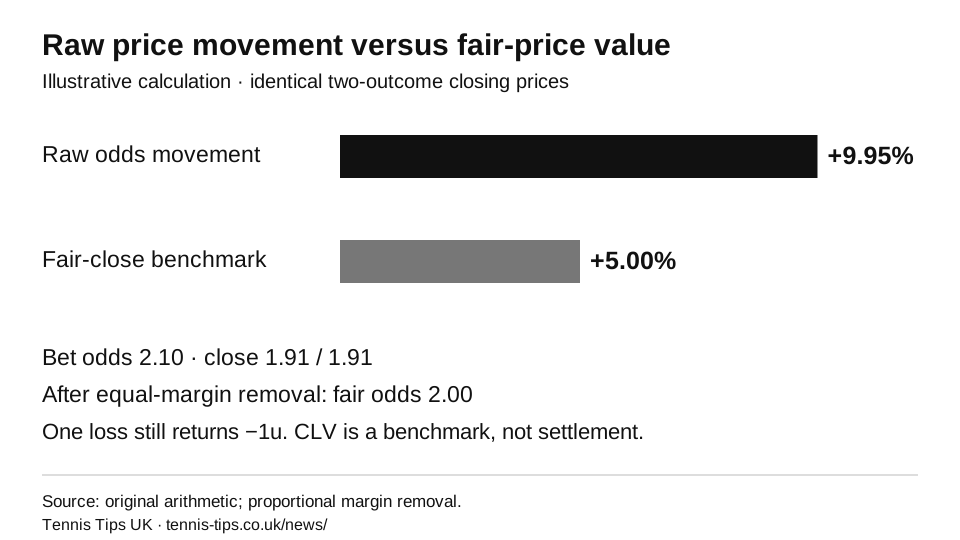
If Player A loses, the settled net return is −1 unit regardless of the positive benchmark. If A wins, the return is +1.10 units. CLV evaluates the accepted price against a reference, while settlement records what actually happened. Assessing both avoids using a single lucky win or unlucky loss as the entire verdict on a decision.
What does the published tennis evidence say?
Joseph Buchdahl’s Pinnacle study published on 6 September 2019 analysed 68,361 matches across ATP, WTA, Challenger and ITF, dated 12 May 2015–19 July 2019. Its opening-to-fair-closing-price regression had a reported slope of 0.825 rather than 1. Buchdahl interpreted this as evidence that the closing market was not a perfect predictor of returns.
The paper discussed a discrepancy between Nishikori Picks’ reported results and closing-price expectations. That is a reason to investigate CLV’s assumptions, not evidence that an individual’s future results are assured. The article is available in a Pinnacle-attributed republication. We have not obtained and independently rerun the complete underlying price dataset.
Those findings are historical and combine competition levels. They do not establish that today’s ATP moneyline market behaves identically, that every bookmaker’s close is equally informative, or that a particular modern strategy has an edge. The practical question is whether the chosen benchmark predicts outcomes reasonably well in the market and period you actually use.
Why CLV remains useful
- It separates execution from the match result. Consistently accepting prices that later become shorter can identify timely execution without waiting for every bet to settle.
- It creates an external comparison. A bettor’s probability estimate is subjective; a recorded market close provides another observable reference.
- It can reveal price slippage. Compare the advised price, the actual price obtained and the closing benchmark. An apparently attractive selection can become unattractive after movement.
- It can expose inconsistent records. A log of two-sided prices and timestamps is harder to manipulate than a retrospective statement that a bet “was value”.
Where CLV can mislead
The closing market is a proxy. More information does not mean perfect information. Limits, liquidity, correlated bettors, anchoring and unreported player circumstances can affect the close. A useful benchmark can still be biased in particular subsets.
Margin allocation is an assumption. Proportional removal treats the overround uniformly in probability terms. Alternative power or other methods allocate it differently. Longshots may therefore receive materially different fair probabilities. Record the method and test sensitivity instead of selecting whichever one makes a strategy look strongest.
Your own action can affect the comparison. In a thin market, betting or sharing a selection may move prices. Positive CLV then partly reflects demand generated by the recommendation, rather than wholly independent agreement. Capacity and stake acceptance belong in the audit.
News can arrive after the bet. A late withdrawal scare may improve or worsen CLV without showing whether the original process was sound using information available at the time. Keep a timestamped information record rather than rewriting the rationale after the movement.
Averages conceal composition. A few very large ratios can distort a simple mean. Report bet count, median, distribution, stake-weighted benchmark return and splits by tour, surface and odds range. Two strategies with the same average CLV can carry very different exposure and uncertainty.
Betting costs still matter. Commission, taxes where applicable and worse accepted odds can exceed an apparent edge. A favourable market comparison does not by itself establish a positive net betting return.
A reproducible CLV audit
- Define the market, closing reference and timestamp convention before collecting results.
- Store both closing prices, the accepted bet price, stake, match identifiers and relevant settlement rule.
- Exclude unusable or mismatched quotes explicitly; report how many were excluded and why.
- Compute raw movement and a named margin-adjusted benchmark separately.
- Keep won, lost and void outcomes in the complete record. A missing close should remain missing rather than being imputed from an unrelated bookmaker.
- Compare predictions with outcomes in later chronological samples. Examine calibration, realised return, costs and uncertainty alongside CLV.
- Investigate changes in performance across periods without endlessly changing the rules to fit the past.
| Field | Why retain it? |
|---|---|
| Bet price and timestamp | Shows the price that was genuinely available at the decision. |
| Both closing prices and timestamp | Allows the margin calculation to be reproduced. |
| Accepted stake and commission | Separates a quoted opportunity from executable net value. |
| Settlement and void reason | Prevents different betting contracts being mixed. |
| Missing-data flag | Makes coverage gaps visible rather than silently favourable. |
How we use the idea at Tennis Tips UK
Market prices and price movement are useful context for our research and human review. The public record shows recorded odds and settled outcomes; it should not be presented as an independently verified CLV database. We do not publish our private scoring logic, and no proprietary screening score by itself proves positive expected value.
Read the selection-process explanation and complete supplied record. The current Members’ Club sends around two English pre-match moneyline picks per week. Research articles are educational and do not promise profits.
Closing prices: inspect calibration, not just movement
Buchdahl’s 2019 discussion gives approximate examples in which raw implied chances of 90% corresponded to 89% observed wins, while 10% corresponded to 6%. These include bookmaker margin and are selected descriptive points, not margin-free probabilities or a newly estimated calibration curve.
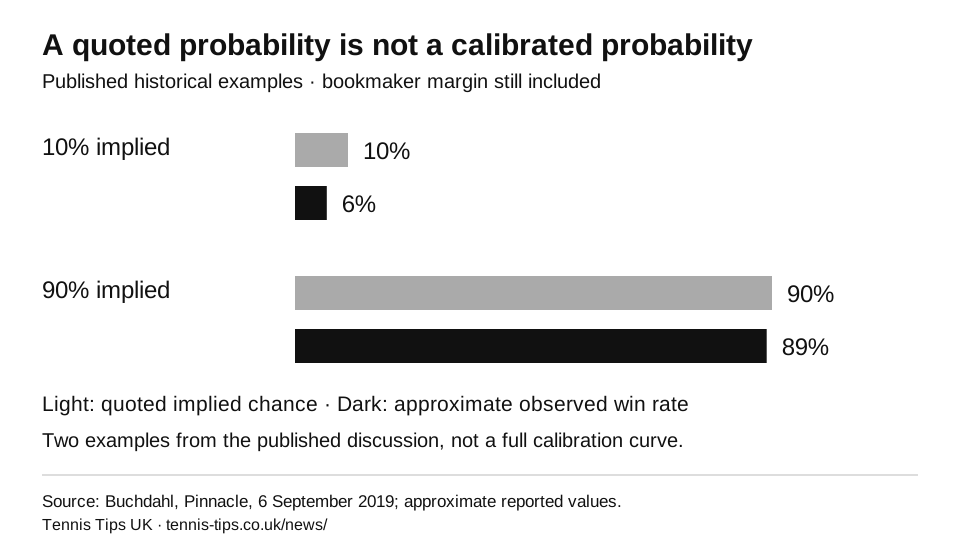
Those numbers show why simply treating1/odds as truth can be particularly misleading at longer prices. They do not identify the fair chance in an individual match. A useful audit would retain the full distribution of predictions, counts in each probability band, sampling uncertainty and the effect of the chosen margin-removal method.
Nishikori’s more recent perspective
In a first-person article dated12February2026, nishi describes CLV as something monitored alongside realised results, not the sole basis of his evaluation. He also discusses the difference between a reference quote and actual fills when betting moves the market. This is practitioner testimony, not an independent audit of an anonymous syndicate or proof of an attainable return.
This perspective is compatible with treating CLV as informative but incomplete. It should not be converted into either “CLV is useless” or “beating the close guarantees profit”. The stronger question is whether a specified price benchmark adds reliable information about later outcomes under your real execution conditions.
| Evidence | What it can support | What it cannot establish alone |
|---|---|---|
| Historical market-wide calibration | Whether a reference price has systematic forecasting errors in that sample. | The correct fair probability for a particular future selection. |
| Practitioner experience | Operational issues worth investigating, including quote-to-fill differences. | Causal explanations or verified generalisable profits. |
| A recorded-price results ledger | Settled outcomes at the recorded convention. | CLV if contemporaneous two-sided closing prices were not stored. |
| Prospective probability and quote audit | Whether a named process keeps performing in later observations. | Certainty that the next bet wins or the market remains unchanged. |
Additional sources
nishi: How Betting Syndicates Work,12February2026. Quote execution and CLV discussion are attributed personal observations. No private syndicate details are inferred.
Sources and scope
- Buchdahl, Joseph. Pinnacle, 6 September 2019: How efficient is the tennis betting market?
- Nishikori Picks, the researcher referenced in that debate. The evidence cited here comes from the listed published articles rather than individual social-media posts.
- TennisRatings: Statistics & Modelling, for an independently published methodological perspective.
Reviewed 13 October 2026. The graphic and worked numbers are our own illustrative arithmetic. The historical study is attributed evidence, not a newly replicated backtest.
See the wider picture.
Read the research alongside the complete results record. See every win and loss and how our proprietary data model and human review select picks.
To interpret prices alongside outcomes, read our research on closing line value. It explains what a market benchmark can show and where it can mislead.
Payment & membership details
Credit and debit cards are accepted through Stripe. PayPal, Apple Pay and Link are also offered where available. Stripe displays the payment options available for your device and country at checkout.
£49.99/month is the base membership price. Stripe may show a local-currency price; check the first payment and renewal amount before subscribing.
All picks and member emails are delivered in English. International members are welcome where betting is legal.
You manage your membership through Stripe and can cancel whenever you choose, without contacting us for approval. Cancellation and refunds are separate.
Member reviews: TipsterCheck ↗ Trustpilot ↗
Maximum 50 paid members. No bookmaker affiliate links. Historical results are before fees and do not guarantee future returns.
Explore tennis betting value and profitability, units and bankroll management, or the tennis picks and results archive.
Follow the record first
Free public result updates.
Follow new public bet reports by email, with their recorded results and occasional membership invitations. Paid pre-match picks are a separate service.
Confirmation required. Unsubscribe at any time. Privacy policy.