
Tennis Tips UK · Research & reports
Tennis tie-break betting: does an 8–2 record predict value?
Published October 26, 2026
By The Team @ Tennis Tips UK · 26 October 2026
A player has won eight of their last ten tie-breaks. Is that evidence of an advantage—or a compelling story built from ten results? Tennis tie-break betting rewards careful interpretation of what a statistic measures. A win percentage describes the past; it does not automatically price the next tie-break, set or match.
The answer: Use tie-break records as a prompt for investigation, not a stand-alone betting signal. Separate underlying serve-and-return strength from a short run of close finishes, account for opponents and scoring format, and compare a defensible probability with the available price. Our illustrative calculations show that an 8–2 record can coexist with substantial uncertainty. They do not identify a profitable betting system.
What a tie-break record actually measures
Three different questions often get compressed into one statistic: how likely a set is to reach a tie-break; who is likely to win it if it happens; and who is likely to win the whole match. These are different probabilities. A player who holds serve frequently may reach many tie-breaks, but their return game and the opponent’s serve still matter once the breaker begins.
The ITF’s 2026 Rules of Tennis describe the standard tie-break as first to seven points with a two-point margin. The first server serves one point, followed by alternating two-point service turns. Alternative scoring procedures also exist. Check the event’s format rather than mixing seven-point set tie-breaks and ten-point match tie-breaks indiscriminately.
A historical 80% tie-break win rate is conditional on the particular breakers the player contested. It is not an 80% chance of winning today’s match. Even as a forecast of today’s tie-break, it leaves unanswered questions about opposition, surface, fitness, time period and the number of observations.
The 8–2 problem: same percentage, different evidence
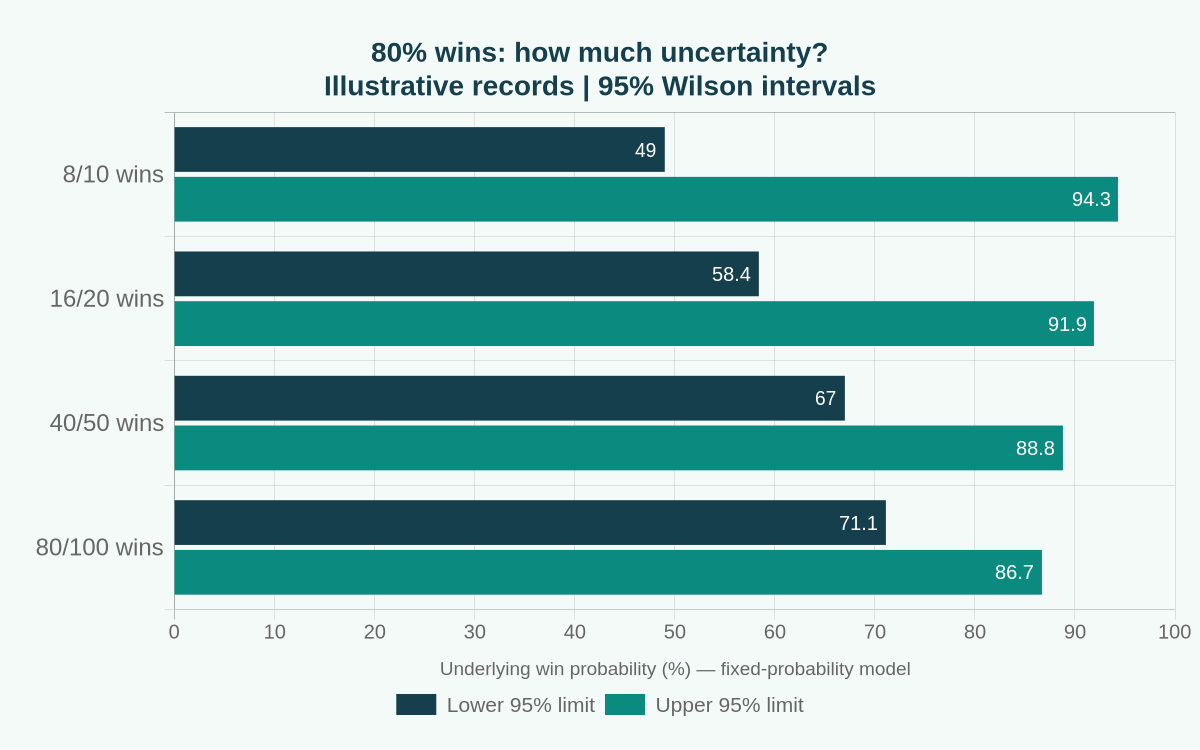
Consider four invented records: 8 wins from 10 breakers, 16 from 20, 40 from 50, and 80 from 100. All show an 80% win rate. They do not provide equal precision. To illustrate the difference, we calculated two-sided 95% Wilson confidence intervals using the method documented by NIST.
| Wins / played | Observed rate | 95% Wilson interval |
|---|---|---|
| 8 / 10 | 80% | 49.0%–94.3% |
| 16 / 20 | 80% | 58.4%–91.9% |
| 40 / 50 | 80% | 67.0%–88.8% |
| 80 / 100 | 80% | 71.1%–86.7% |
The ten-breaker example cannot pin down a stable underlying probability closely. Its interval includes 50%. The hundred-breaker example is more precise under the same model, but accumulating that many observations can introduce a different problem: older performances may no longer represent today’s player.
These intervals describe the behaviour of a statistical procedure under repeated sampling. They are not a statement that there is a 95% probability today’s win chance lies inside the displayed range. Real tennis also violates the simple model: opponents differ, conditions change and observations can be dependent. The table is an uncertainty lesson, not a ready-made betting forecast.
Why searching for a hot record changes the story
Now suppose a hypothetical competitor has exactly a 50% chance of winning each of ten independent trials. The probability of winning at least eight is (45 + 10 + 1) / 1,024 = 5.47%. The three numerator terms count the possible sequences with eight, nine and ten wins.
That is uncommon for one competitor selected in advance. But imagine inspecting twenty independent ten-trial sequences and highlighting whichever looks best. The probability that at least one contains eight or more wins becomes 1 − (1 − 56/1,024)20 = 67.53%.
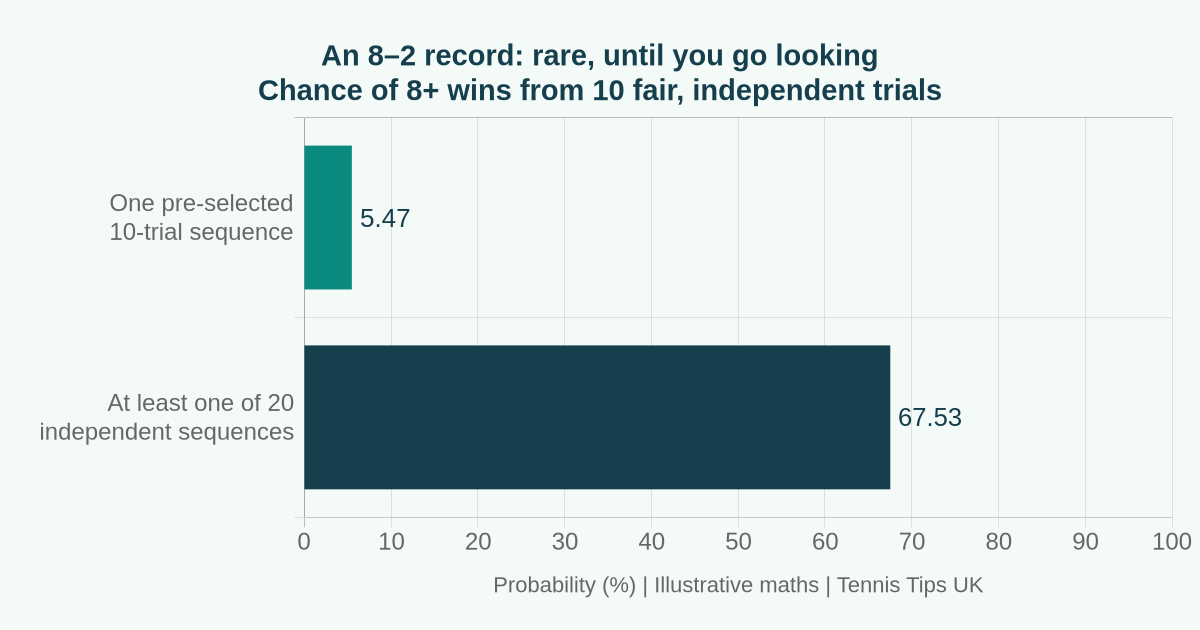
The distinction matters when someone selects a player, date range or surface after seeing the results. “Eight of the last ten” may be the most flattering window among many examined. That does not make the record false. It makes the selection process part of the evidence.
Actual tour records overlap because players face one another; not every player is a 50–50 proposition. Our twenty-sequence calculation therefore must not be presented as the real probability of finding a hot ATP player. Its purpose is to demonstrate why a pre-specified test is stronger than a retrospective leaderboard anecdote.
Does tie-break skill exist?
Being good at tennis plainly matters. The harder question is whether a recent tie-break record adds repeatable information beyond broader playing strength. In his 2 January 2019 Tennis Abstract analysis, Jeff Sackmann compared tie-break results with expectations based on serve and return performance. He argued that unusually strong or weak records often reflect luck beyond underlying ability.
One historical example was John Isner: 42 wins in 68 tie-breaks in 2017 against an expectation of 34 in that analysis, followed by 39 wins in 73 in 2018 against an expectation of 41. This is the source author’s historical modelling example, not our own backtest or a claim about any current player’s ability.
The useful lesson is to ask what the record adds after accounting for existing information. That article does not prove pressure never matters, and it does not establish a present-day betting edge. A psychological explanation should be treated as a hypothesis to test, rather than inferred automatically from a handful of decisive points.
Regression towards a more representative level also does not mean a player is “due” to lose. Under the independent 50–50 example, winning eight of ten leaves the next trial’s chance at 50%. It does not create a compensating run of losses. Automatically opposing a hot player repeats the same mistake as automatically backing one.
A better way to evaluate a tie-break betting claim
- Define the market and format. Record whether the claim concerns a tie-break occurring, a tie-break winner, total games or the match winner. Confirm scoring and settlement rules. A probability for one event cannot be substituted into another market.
- Inspect the denominator. Record wins and losses, not just a percentage. State the dates, tour level, surface, opponent mix and any exclusions. Ask whether the start date was chosen before or after viewing the streak.
- Build a baseline. Consider serve and return performance against comparable opposition, recent changes in health or conditions, and uncertainty in those inputs. Read our review of tennis metrics and value for the broader framework.
- Test the extra information. Compare a baseline model with the same model plus the proposed tie-break feature. Freeze the specification before evaluating later matches. Avoid using statistics from the match being predicted.
- Compare with the actual price. Include commission where applicable, attainable odds, settlement and the possibility of model error. If the evidence cannot support the adjustment, leaving the price unchanged—or choosing not to bet—is reasonable.
For a serious research project, use a chronological holdout and report how many forecasts and settled bets it contains. Compare probability accuracy and calibration as well as returns. A model that predicts 60% events should be assessed on whether those events occur around that rate across a suitable sample. Multiple trials of different windows should be disclosed; the final winning variant is not an untouched test.
Worked pricing example: an attractive record can still be expensive
Assume, purely for illustration, that a separately built model assigns a player a 55% chance of winning a particular tie-break. That number is stipulated; it is not inferred from the 8–2 record. At decimal odds of 1.80, the break-even probability before costs is 1 / 1.80 = 55.56%. Expected net return per unit staked is p × odds − 1, giving 0.55 × 1.80 − 1 = −1.0%.
At 1.90, the same stipulated estimate produces +4.5% before costs. If an illustrative 2% commission applies only to winnings on this isolated bet, expected return becomes p × (odds − 1) × (1 − commission) − (1 − p), or +3.51%. Actual exchange commission can depend on net market winnings and account terms; this simplified calculation excludes those complications.
Now change the assumed probability from 55% to 52%, holding 1.90 odds and that commission convention fixed. Expected return falls to −2.14%. Three percentage points of probability error reverse the sign. This sensitivity is why an eye-catching historical win rate should not be allowed to stand in for a calibrated estimate.
These are mathematical expectations across hypothetical repetition, not promised returns from one bet. Use the odds and probability calculator to check conversions, and our closing-line-value research to understand the limits of a market benchmark.
Methods, reproducibility and limitations
Evidence type: an educational analysis with original deterministic calculations and a credited historical research example. We did not collect a new ATP dataset, fit a predictive model or run a profitability backtest. No search-volume or traffic forecast is claimed.
For Figure 1, let n be trials, p̂ = wins/n and z = 1.96. The Wilson centre is (p̂ + z²/(2n))/(1 + z²/n). The half-width is z × √[p̂(1 − p̂)/n + z²/(4n²)]/(1 + z²/n). Subtract and add the half-width, then multiply by 100. The table rounds to one decimal place; the calculation uses unrounded values.
For Figure 2, the binomial tail is Σ from k = 8 to 10 of C(10,k) × 0.510 = 56/1,024. For twenty independent sequences the complement rule gives 1 − (968/1,024)20. The price examples use the formulas stated above. Original graphics may be shared with attribution and a link to this article; retain the hypothetical-data labels.
The decision to take away
A strong tie-break record can identify a question worth researching. It cannot, by itself, answer whether the next available price offers value. Check the sample, the selection process, the opponent-adjusted baseline and the price. Treat uncertainty as part of the analysis rather than an inconvenient footnote.
Sources checked 26 October 2026: ITF, 2026 Rules of Tennis; NIST/SEMATECH, Confidence intervals for proportions; Jeff Sackmann, The Effect of Tiebreak Luck, 2 January 2019. Direct links appear alongside the claims they support.
18+. Educational research, not a betting recommendation. Betting involves risk, including loss of your stake. Never chase losses or bet money you cannot afford to lose. Tennis Tips UK does not use bookmaker affiliate links.
See the wider picture.
Read the research alongside the complete results record. See every win and loss and how our proprietary data model and human review select picks.
To interpret prices alongside outcomes, read our research on closing line value. It explains what a market benchmark can show and where it can mislead.
18+ · Betting involves risk · Past results cannot guarantee future profit.
Our proof standard: for each newly settled club pick, we aim to publish the original email screenshot showing the date and time sent to members, alongside a screenshot of the quoted bookmaker or exchange odds. Check the linked result report for the evidence available; older archive entries may use different formats.
Payment & membership details
Credit and debit cards are accepted through Stripe. PayPal, Apple Pay and Link are also offered where available. Stripe displays the payment options available for your device and country at checkout.
£49.99/month is the base membership price. Stripe may show a local-currency price; check the first payment and renewal amount before subscribing.
All picks and member emails are delivered in English. International members are welcome where betting is legal.
You manage your membership through Stripe and can cancel whenever you choose, without contacting us for approval. Cancellation and refunds are separate.
 Trustpilot
 TipsterCheck
Member reviews: TipsterCheck ↗ Trustpilot ↗
Maximum 10 paid members. No bookmaker affiliate links. Historical results are before fees and do not guarantee future returns.
Explore tennis betting value and profitability, units and bankroll management, or the tennis picks and results archive.
FREE TENNIS BETTING PICK
One upcoming selection. Free.
Subscribe free and confirm your email to qualify for one upcoming pre-match tennis betting pick. Our team will send it manually when the next club selection is available.
You’ll also receive published club results and an exclusive discount code by email after confirmation, if you decide to become a full paid club member. Membership is optional.
- Tournament
- Locked until sent by email
- Match
- Locked until sent by email
- Advised bet
- Locked until sent by email
Tap or click to see how to unlock your free pick.
Check your inbox to confirm. Missing the email? Check Spam, Junk or Promotions and add the sender to your contacts. One free pick per eligible new confirmed subscriber. 18+. Betting involves risk. Unsubscribe at any time.Privacy policy.