
Tennis Tips UK · Research & reports
Can AI Make Money from Tennis Betting? Evidence, Odds and the Limits of Prompts
Published October 26, 2026
Can AI make money from tennis betting? It can help build models, analyse large datasets and investigate possible mispricing. That is very different from showing that a chatbot’s betting tips are profitable. A simple prompt is available to your competitors too, and the public information it summarises is often already reflected in the odds. An accurate tennis opinion can therefore have no betting value at all.
The defensible conclusion is not that markets are perfect or that every AI system must lose. It is that access to AI is not, by itself, an edge. Sustainable profit would require reliable information or analysis that improves on the market, available prices that preserve that advantage, and evidence from bets recorded before their results are known. This article examines each requirement, including an original audit of Tennis Tips UK’s results.
Research and data checked: 26 October 2026. Our archive analysis contains 493 records, including 479 won or lost selections and 14 voids. It is not a trial of AI-generated tips. Numerical examples are labelled where assumptions replace observed data. 18+; betting can cause financial harm and is not a dependable income source.
What do we mean by “AI tennis betting”?
The label covers several quite different activities. A conversational assistant can explain form, summarise reports and draft a prediction. A statistical model can estimate win probabilities from historical features. An automated research system can collect prices, reconcile data and flag discrepancies. A commercial tipping product can wrap any of these in a subscription and call the result AI.
Those distinctions matter. A fluent paragraph does not demonstrate a trained forecasting model. A numerical probability does not demonstrate calibration. A model with good forecasting scores does not demonstrate profitable execution. And a profitable historical simulation does not establish that a customer could have obtained its assumed prices.
A chatbot connected to a well-tested model and current data may be a useful interface to serious analysis. The evidence belongs to that underlying process, however, not to the fact that the answer appears in a chat window. Asking three assistants for the same selection is not three independent confirmations when their information, training material or quoted market prices overlap.
Why simple prompts usually do not create an edge
Consider a typical request: “Analyse recent form, head-to-head, surface, injuries and rankings, then give me the best tennis bet today.” Each item may be relevant to the match. None is inherently information that the market has missed.
If a clay specialist is stronger on clay, the relevant question is not whether the assistant recognises that fact. It is whether the offered price understates the effect. A favourite can have superior form, a favourable matchup and a higher chance of winning while still being an unattractive bet at the quoted odds.
The market does not need to have seen your exact prompt. Its participants only need to have incorporated the same underlying information, perhaps through their own models, trading judgement or earlier bets. Repackaging familiar inputs in a polished explanation does not make them new information.
This creates a competitive problem. A method that is cheap, obvious and widely reproducible is unlikely to remain a scarce advantage merely because one person discovers it. If enough informed demand reacts to an underpriced player, prices can adjust. The potential gain then shrinks or disappears for later bettors. That is the economic argument; it is not a claim that we have measured how quickly every tennis market reacts to chatbot activity.
There are exceptions worth investigating: neglected competitions, difficult-to-interpret evidence, better probability modelling or genuinely faster access to usable information. But thinner markets can also mean worse data, wider margins, lower limits and greater execution problems. “Less efficient” does not automatically mean “easy money”.
The practical default is that common facts surfaced by a simple prompt are already substantially priced in, leaving no demonstrated extra value. Anyone claiming an exception needs to show it. The absolute claim that every public fact is always perfectly priced would go beyond the evidence.
A correct prediction can still be a losing bet
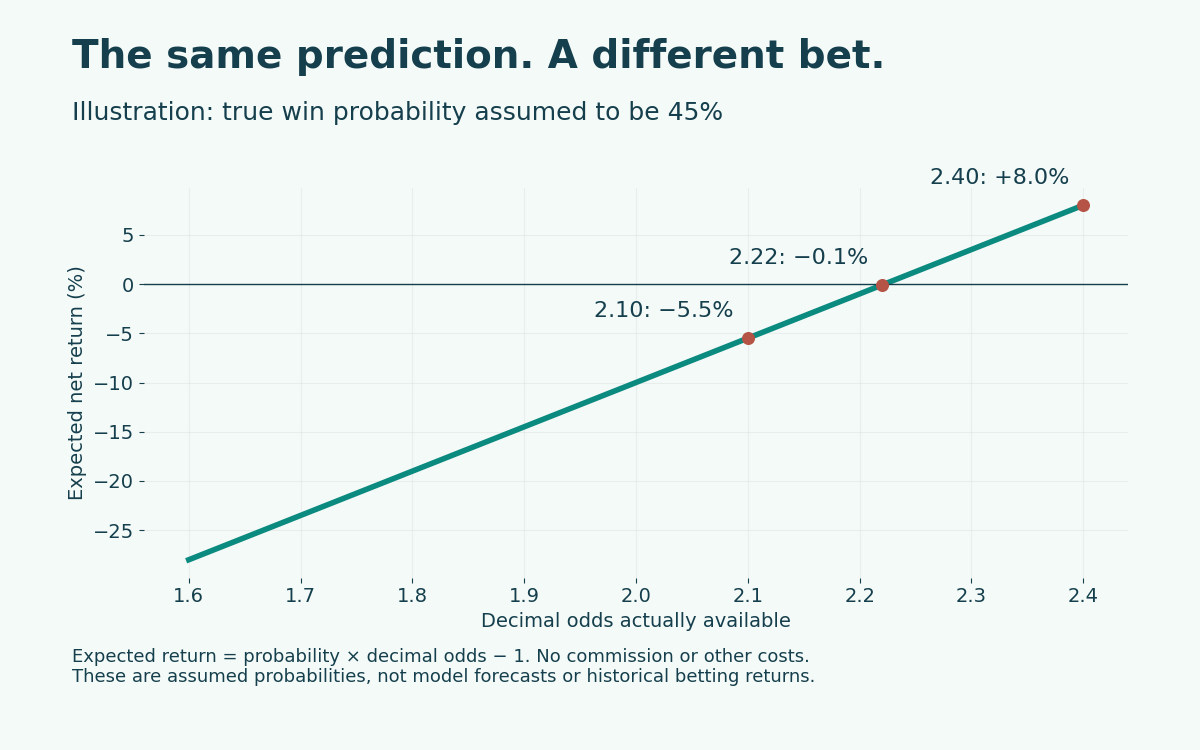
For a one-unit win-or-lose bet at decimal odds O, with true winning probability p, expected net profit is p × O − 1. The break-even probability before additional costs is 1/O. The challenge is estimating p more accurately than the price warrants, not merely naming the likelier winner.
Here is an illustrative example, not an AI forecast. Suppose a player’s true chance is 45%. At 2.40 the expected return is 0.45 × 2.40 − 1 = +8%. At 2.22 it is −0.1%, and at 2.10 it is −5.5%. The player, evidence and probability have not changed. Only the available price has changed.
The same distinction explains why headline accuracy can mislead. Winning 70 of 100 one-unit bets at 1.30 produces 70 × 0.30 − 30 = −9 units, a −9% yield. Winning 40 of 100 at 2.60 produces 40 × 1.60 − 60 = +4 units. These are constructed examples, not observed performance. A higher strike rate is not necessarily a better betting system.
Nor is the reciprocal of a quoted price a guarantee of the true probability. Two illustrative opposing prices of 1.80 and 2.10 imply 55.56% and 47.62%, totalling 103.17%. That excess is the overround. Normalising them gives approximately 53.85% and 46.15%, but that is only one way of removing the margin, not proof of the players’ actual chances.
Use our tennis odds calculator to check the arithmetic. An assistant that identifies a likely winner without specifying a minimum acceptable price has left out the central betting decision.
What published research actually says
Sascha Wilkens’ 2021 tennis study examined 25,204 ATP and 13,755 WTA singles matches from 2010–2019. It compared several statistical and machine-learning approaches using rolling training periods and subsequent-year predictions. Prediction accuracy was around 70%, broadly comparable with the bookmaker benchmark. Most tested betting strategies had negative longer-term returns; ensembles offered some encouraging results, but volatility and practical limitations weakened the case. This is evidence against easy profits from ordinary modelling inputs, not proof that no future model can work. Read the original study.
A separate example shows why source checking matters. Walsh and Joshi’s 2024 study concerned NBA betting, not tennis. Its original results were subsequently corrected after implementation errors were found. The 2025 corrigendum changes the reported average return for calibration-driven systems from +34.69% to −9.77%; the best corrected system still returned +23.13%. Those are different summaries of different systems, not interchangeable promises of profit. The authors retained their relative conclusion favouring calibration over accuracy. Read the correction.
The authors’ code repository also flags the correction. An AI answer quoting only the earlier positive average could sound evidence-based while leaving the reader with a materially outdated conclusion. We have checked the published correction; we have not independently rerun that NBA experiment.
These studies examine particular models, datasets and periods. They do not directly test today’s generic chatbot prompts. Their relevance is narrower and stronger: market odds are a demanding benchmark, forecasting quality and profitability are different, and even academic-looking results need implementation and version checks.
Our data: what AI could discover in Tennis Tips UK’s results
We downloaded the public data behind our results tracker on 26 October 2026. The snapshot covers recorded dates from 21 January 2024 to 26 October 2026: 170 wins, 309 losses and 14 voids. Every record carries a one-unit stake. Excluding voids from settled turnover leaves 479 units staked and +186.3588 units of recorded profit, a +38.91% historical yield before additional costs.
Those figures describe the site’s selected bets at its recorded odds. They are not the results of betting every tennis match, an independently audited estimate of achievable customer returns, or an AI model’s track record. The extract does not identify which selections, if any, involved AI. It also lacks systematic model probabilities, rejected candidates, decision-time feature snapshots and closing prices.
This means an assistant can calculate and challenge historical performance, but cannot honestly infer “AI made 38.91%” from this ledger. To establish AI’s incremental contribution, we would need a documented comparison between otherwise comparable decision processes, with and without the AI component.
A historical rule that looked compelling
Imagine asking an assistant to choose the most profitable odds band using only the archive’s 2024–2025 selections, then applying that same band to 2026. We used five bands: below 2.00; 2.00 to below 3.00; 3.00 to below 5.00; 5.00 to below 10.00; and 10.00 or higher. Boundaries use stored odds without rounding. Wins return odds minus one; losses return minus one; voids are excluded.
| Recorded odds band | 2024–2025 bets | 2024–2025 yield | 2026 bets | 2026 yield |
|---|---|---|---|---|
| Below 2.00 | 7 | −15.18% | 0 | Not applicable |
| 2.00–below 3.00 | 141 | −8.89% | 61 | +32.70% |
| 3.00–below 5.00 | 100 | +46.28% | 42 | +0.69% |
| 5.00–below 10.00 | 76 | +103.62% | 14 | −34.00% |
| 10.00 and above | 31 | +50.76% | 7 | +624.29% |
The strongest earlier band was 5.00 to below 10.00: +78.752 units on 76 selections. Its later record was −4.76 units on 14 selections. An explanation written after seeing the earlier winners could have sounded compelling, but would not have protected a follower from the later losses.
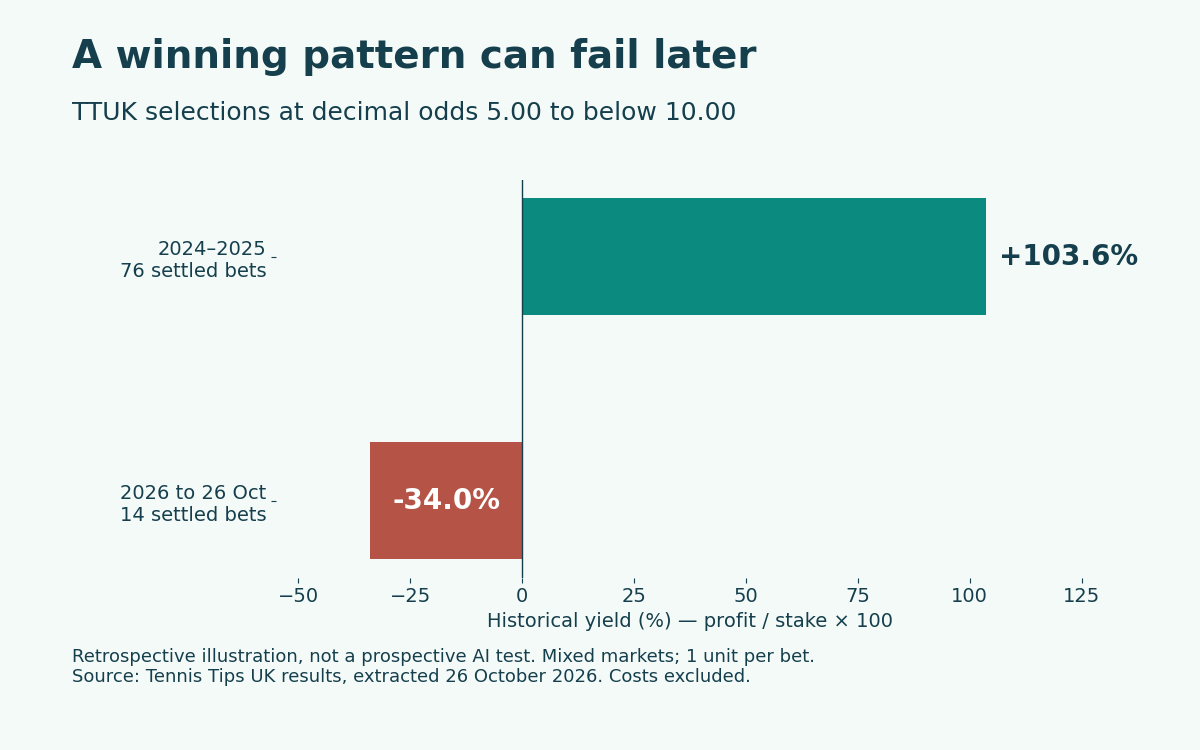
This is deliberately a retrospective chronological illustration. We constructed it after the results were known, using boundaries also examined in our earlier research. It is not a preregistered strategy, an untouched holdout, or a live AI trial. The 2026 comparison nevertheless makes a useful descriptive point: the historical ranking of the bands did not persist consistently.
The seven 2026 selections at 10.00 or higher also show how unstable small samples can be. One recorded winner at 40.39 contributes +39.39 units of that band’s +43.70-unit profit. Remove that winner as a sensitivity check and the remainder is +4.31 units on six bets, or +71.83%, rather than +624.29%. This is not a reason to delete legitimate winners; it is a reason to show their influence.
Fourteen later bets cannot establish that the 5.00–below-10.00 band has a negative expected return. Seven longshots cannot establish an extraordinary sustainable edge either. The archive mixes markets and competitions, and the underlying selection process may change. Bets involving the same players or tournament conditions may also be correlated. We therefore do not attach a simplistic binomial confidence interval to these variable-odds profits or turn the comparison into a forecast.
For the broader historical band analysis, see which tennis betting odds range was most profitable. That earlier article has a different cutoff and 478 settled bets; this fresh extract includes the subsequently added losing Etcheverry selection, bringing the total to 479. Neither article supplies a mechanical recommendation to back a particular odds range.
Why asking AI to find patterns can manufacture confidence
Suppose you try five odds bands, four surfaces, several tournament levels, different months and a range of minimum sample sizes. Even with no stable predictive advantage, some combinations can look attractive by chance. If the assistant reports only the best combination, the reader cannot see how many unsuccessful ideas were discarded.
This is multiple testing and selection bias. The danger grows when the same dataset is repeatedly queried: “Try another cutoff”, “Exclude that tournament”, “What about players returning from injury?” Each refinement can fit the historical noise more closely. A clear story explaining the final subgroup does not undo the search process that selected it.
AI makes exploration faster, which is useful. It also makes it easier to generate far more candidate explanations than the evidence can support. The remedy is to log the research search, distinguish exploration from testing, freeze the chosen rule and evaluate it on genuinely later observations. A failed later test should remain visible.
Our archive also illustrates a missing-data trap. “Does backing injured players work?” cannot be answered responsibly by guessing injury status from a player’s name or a retrospective news search. We would need a consistent definition, a source published before each bet, severity and uncertainty coding, and a comparison population. An assistant should identify these missing requirements instead of filling the column with plausible fiction.
Where AI can genuinely improve the research process
Cleaning and auditing records
Useful work includes checking duplicate selections, reconciling total stakes and profit, identifying missing results, and distinguishing match-winner bets from handicaps or set markets. Name matching can benefit from automation, but ambiguous identities need review. A clean ledger is a prerequisite for testing an edge, not an edge in itself.
Building better questions and features
AI can help translate an idea into a measurable variable: surface-adjusted performance, opponent-adjusted service results, rest time, or travel. It can also explain why a feature may be redundant with information already in the price. The useful question is whether it adds predictive information beyond a strong benchmark, not whether it sounds relevant to tennis.
Reading source material at scale
Assistants can organise reports and highlight potentially relevant information for human verification. Every important claim still needs its source, publication time and uncertainty. An old injury article, a report about another player with a similar name, or a speculative social post can otherwise become a confident but false premise.
Writing reproducible analysis
Generating code, documenting calculations and producing charts can save substantial work. The calculations should execute against identified data and be reconciled independently with known totals. Ask for row counts, exclusions, formulas and sensitivity checks. A narrated calculation that never actually ran is not a backtest.
AI may therefore create value by improving research productivity even where it does not improve betting returns. Saving an analyst time and finding a profitable wager are different outcomes and should be measured separately.
What a credible AI betting test would require
1. Specify the decision before testing it
Define competitions, market, decision time, permitted sources, price threshold, staking and settlement rules. Specify when the system must abstain. Save model and prompt versions, data timestamps and all candidate matches, including rejected bets. Otherwise a profitable-looking record can emerge from selective publication.
2. Prevent information from the future entering the model
A prediction for Monday cannot use statistics from Monday’s completed match. Full-season averages, later rankings, revised injury diagnoses and closing prices unavailable at the decision time can all leak future information. Split chronologically, calculate features using only earlier observations, and keep tuning separate from final evaluation.
Historical tests of general-purpose language models have another problem: the model may already have encountered the old match result during training. Telling it to pretend the match has not happened does not reliably remove that knowledge. A prospective record, or a carefully controlled system whose inputs and training provenance can be audited, is more persuasive than asking a modern chatbot to predict famous old matches.
3. Compare with market probabilities and simple models
At minimum compare against a price-based benchmark and a simple tennis forecasting baseline. If adding an elaborate AI component does not improve held-out probability forecasts or economic decisions, complexity has not earned its place. Also compare the same process without the AI component: that is what tests incremental benefit.
4. Evaluate calibration as well as accuracy
Among many predictions near 60%, approximately 60% should win if the model is well calibrated in that group. Assess this across probability ranges, with uncertainty and adequate counts. Brier score averages squared probability errors; log loss penalises confidently wrong predictions. Neither metric alone proves that the model identifies profitable mispricing.
A model can be well calibrated overall yet unreliable precisely where it disagrees most with the market. That disagreement subset is often where its proposed bets are concentrated. Examine those selections separately without repeatedly tuning the rule to the final test results.
5. Test obtainable prices and actual costs
Record a timestamped price from a named source, available liquidity or limits where relevant, the minimum acceptable price and the price actually taken. A historical “best available” quote assembled across bookmakers is not automatically obtainable by every customer. Include subscriptions, data and software costs, and commission where applicable.
For an isolated exchange bet with commission rate c on winnings, an illustrative expected-profit formula is p × (O − 1) × (1 − c) − (1 − p). Actual exchange commission is governed by the relevant account and market rules, so a complete execution ledger must apply those rules rather than blindly charging each winning bet.
Price sensitivity matters most when the supposed edge is small. A model estimating 42% at 2.40 appears to offer +0.8% before costs. If the true probability is 40%, expected return is −4%. A two-percentage-point probability error overwhelms the claimed advantage. More decimal places in the forecast do not reduce that uncertainty.
6. Report the full distribution, not just profit
Publish sample size, turnover, yield, drawdown, losing runs, price changes and performance across meaningful time periods. Distinguish return on total stakes from return on starting bankroll. Report uncertainty with methods appropriate to variable odds and dependence; tournament or time-block resampling may be more defensible than treating every bet as independent. Show sensitivity to the biggest winners without secretly removing them.
There is no universal number of bets that proves an edge. Required evidence depends on odds, effect size, dependence and how many hypotheses were tested. A few hundred bets may still leave substantial uncertainty, especially when rare longshots dominate profit. An arbitrary “100 bets completed” badge is not a statistical certificate.
7. Keep a prospective record and monitor deterioration
Record forecasts and prices before events, preserve losses and voids, and resist changing the method halfway through a test without declaring a new version. Monitor performance against the market and the stated assumptions. A previously useful signal can weaken as competitors adapt or the underlying tennis environment changes.
Closing line value can help assess price quality, but it is not a guarantee of profit or an infallible estimate of truth. Compare like-for-like markets and settlement rules, account for margin, and keep it alongside outcome and calibration measures.
Can staking turn an AI prediction into profit?
No staking formula makes a negative-expectation selection positive. Larger stakes amplify exposure; they do not repair incorrect probabilities. Kelly-style sizing depends on a valid probability estimate and can become aggressive when that estimate is overconfident. Fractional staking reduces exposure relative to full Kelly but does not establish that the underlying edge exists.
Subscription costs also change the practical result. As a purely illustrative calculation, 100 bets of £10 with a genuine 2% expected yield produce £20 expected profit before fixed costs. A £30 monthly tool fee would make that month’s expected net result −£10, before other costs and random variation. Increasing stakes to cover a fee is not a solution to unproven forecasts.
Avoid recovery systems that increase bets after losses. Previous losses do not create value in the next match. The appropriate response to an uncertain or deteriorating model may be to stop using it, not to demand that AI find a more confident selection.
Questions to ask an “AI profitable tips” service
Ask what is actually automated, what data the model uses, and whether the full record was published before matches. Ask for all selections, losses and voids; the quoted and obtainable prices; consistent stakes; results after costs; and an explanation of changes to the model. A high win percentage without odds and stakes cannot establish profitability.
Ask whether results are live, backtested or simulated, whether the final test period was used for tuning, and how many alternative systems were tried. Ask for the largest-winner sensitivity, drawdown and a price-based benchmark. If probabilities are advertised, ask for calibration evidence. “Proprietary AI” does not excuse the absence of a verifiable ledger.
Apply these standards to human tipsters too, including Tennis Tips UK. Publishing our results makes inspection possible; it does not eliminate selection bias, price uncertainty or future risk. Our site does not use bookmaker affiliate links, and this article does not recommend buying an AI service or opening a betting account.
Better questions to ask an AI assistant
A more useful research request is: “Using only the attached ledger, reconcile stakes and profit, list missing fields, separate descriptive findings from predictive claims, and show how results change across time. Do not invent injury or round labels.” This asks for an auditable task instead of a confident tip.
Another is: “For this proposed model, identify every way future information could enter the features. State the benchmark, test period, decision-time odds source and assumptions required to make the claimed return attainable.” A third is: “Find the original research and any corrections; distinguish the best-performing variant from the average result.”
These prompts can improve the quality of the process. They are not themselves a profitable betting strategy. The analyst must still verify the data, execute the calculations and accept that the honest conclusion may be that no usable advantage has been demonstrated.
Methodology and reproducibility
Our original calculations use the public TTUK results endpoint, extracted on 26 October 2026. We counted all 493 records, retained 479 with outcomes “won” or “lost”, and excluded 14 voids from turnover and yield. All recorded stakes were one unit. Profit is stake × (decimal odds − 1) for a winner and minus stake for a loser. Yield is total profit divided by settled stakes, multiplied by 100.
The earlier period includes archive dates before 1 January 2026; the later period runs from that date to the snapshot’s latest record, 26 October 2026. We retained stored dates and full-precision odds, including prices that would cross a band boundary if rounded first. We did not infer actual match start times from archive dates. The five earlier band counts sum to 355 and later counts to 124, reconciling to 479.
The underlying record contains selected tips, not a complete universe of matches or rejected opportunities. Markets are mixed and no consistent injury, round, decision-time probability or closing-price fields are available in the extract. Consequently, we did not fit an AI model, claim a causal effect of odds bands, calculate injury returns, or estimate a prospective AI edge. The endpoint is live and future additions may change its totals; this article’s figures are a dated snapshot.
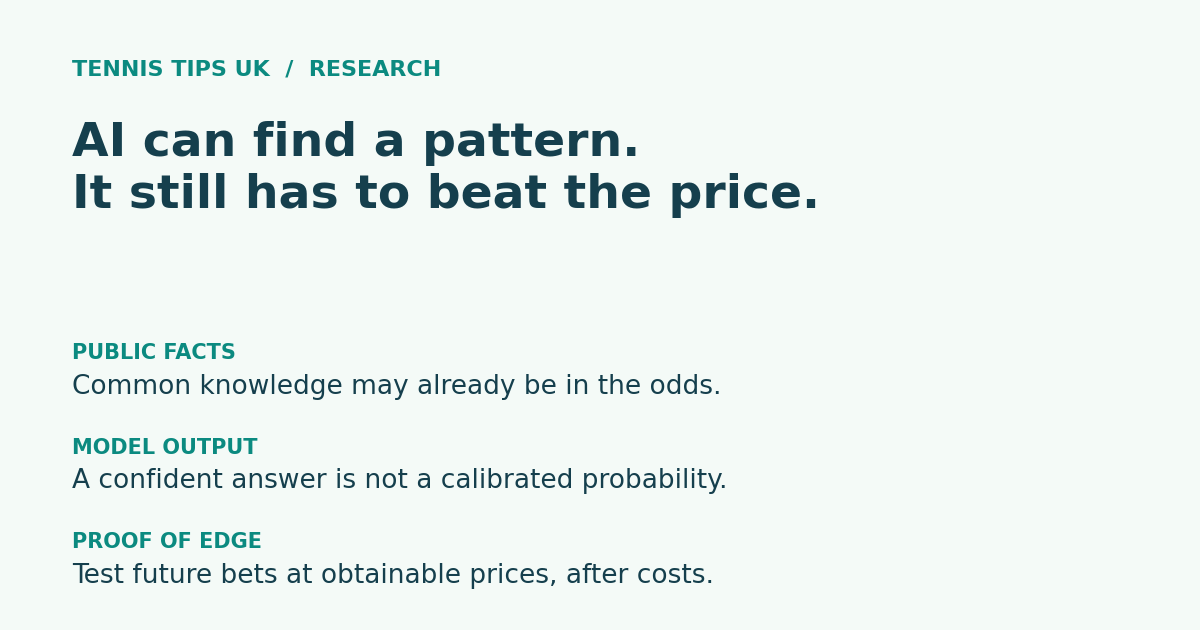
Charts were drawn from the stated calculations. The price chart uses an assumed 45% true probability and excludes costs. The temporal chart uses observed archived returns, not simulated predictions. The summary graphic communicates the argument and contains no performance forecast. Research papers were read as published evidence, not treated as independently reproduced experiments.
Conclusion: AI is useful; an easy prompt is not an edge
AI can help identify potential opportunities, analyse large datasets and challenge weak reasoning. It can also generate plausible stories about noise, repeat outdated research and express unsupported probabilities with great confidence.
The essential commercial reality is that simple prompts are accessible to almost anyone. Their familiar inputs—rankings, recent form, surface and public news—are often already reflected in betting odds. If the price already incorporates the information, the prompt adds no betting value, however persuasive its explanation.
A genuine advantage would have to survive comparison with the market, genuinely later testing, probability uncertainty and real execution costs. Our results case study shows why finding a historically profitable pattern is only the beginning of that investigation. Use AI to improve the analysis; do not mistake access to AI for evidence that you can make money from tennis betting.
Sources and further reading
All links and research checked on 26 October 2026. Primary sources: Tennis Tips UK results tracker and its linked public dataset; Wilkens (2021), Sports prediction and betting models in the machine learning age: The case of tennis, Journal of Sports Analytics 7, 99–117; Walsh and Joshi (2024), Machine learning for sports betting: Should model selection be based on accuracy or calibration?; and their 2025 corrigendum, published online 8 February 2025, with corrected code.
For related site material, visit the Research section and tennis betting research and data tools. 18+ only. Never stake money needed for essential expenses, chase losses or treat gambling as reliable income. Historical results and model outputs do not guarantee future returns.
See the wider picture.
Read the research alongside the complete results record. See every win and loss and how our proprietary data model and human review select picks.
To interpret prices alongside outcomes, read our research on closing line value. It explains what a market benchmark can show and where it can mislead.
18+ · Betting involves risk · Past results cannot guarantee future profit.
Our proof standard: for each newly settled club pick, we aim to publish the original email screenshot showing the date and time sent to members, alongside a screenshot of the quoted bookmaker or exchange odds. Check the linked result report for the evidence available; older archive entries may use different formats.
Payment & membership details
Credit and debit cards are accepted through Stripe. PayPal, Apple Pay and Link are also offered where available. Stripe displays the payment options available for your device and country at checkout.
£49.99/month is the base membership price. Stripe may show a local-currency price; check the first payment and renewal amount before subscribing.
All picks and member emails are delivered in English. International members are welcome where betting is legal.
You manage your membership through Stripe and can cancel whenever you choose, without contacting us for approval. Cancellation and refunds are separate.
 Trustpilot
 TipsterCheck
Member reviews: TipsterCheck ↗ Trustpilot ↗
Maximum 10 paid members. No bookmaker affiliate links. Historical results are before fees and do not guarantee future returns.
Explore tennis betting value and profitability, units and bankroll management, or the tennis picks and results archive.
FREE TENNIS BETTING PICK
One upcoming selection. Free.
Subscribe free and confirm your email to qualify for one upcoming pre-match tennis betting pick. Our team will send it manually when the next club selection is available.
You’ll also receive published club results and an exclusive discount code by email after confirmation, if you decide to become a full paid club member. Membership is optional.
- Tournament
- Locked until sent by email
- Match
- Locked until sent by email
- Advised bet
- Locked until sent by email
Tap or click to see how to unlock your free pick.
Check your inbox to confirm. Missing the email? Check Spam, Junk or Promotions and add the sender to your contacts. One free pick per eligible new confirmed subscriber. 18+. Betting involves risk. Unsubscribe at any time.Privacy policy.