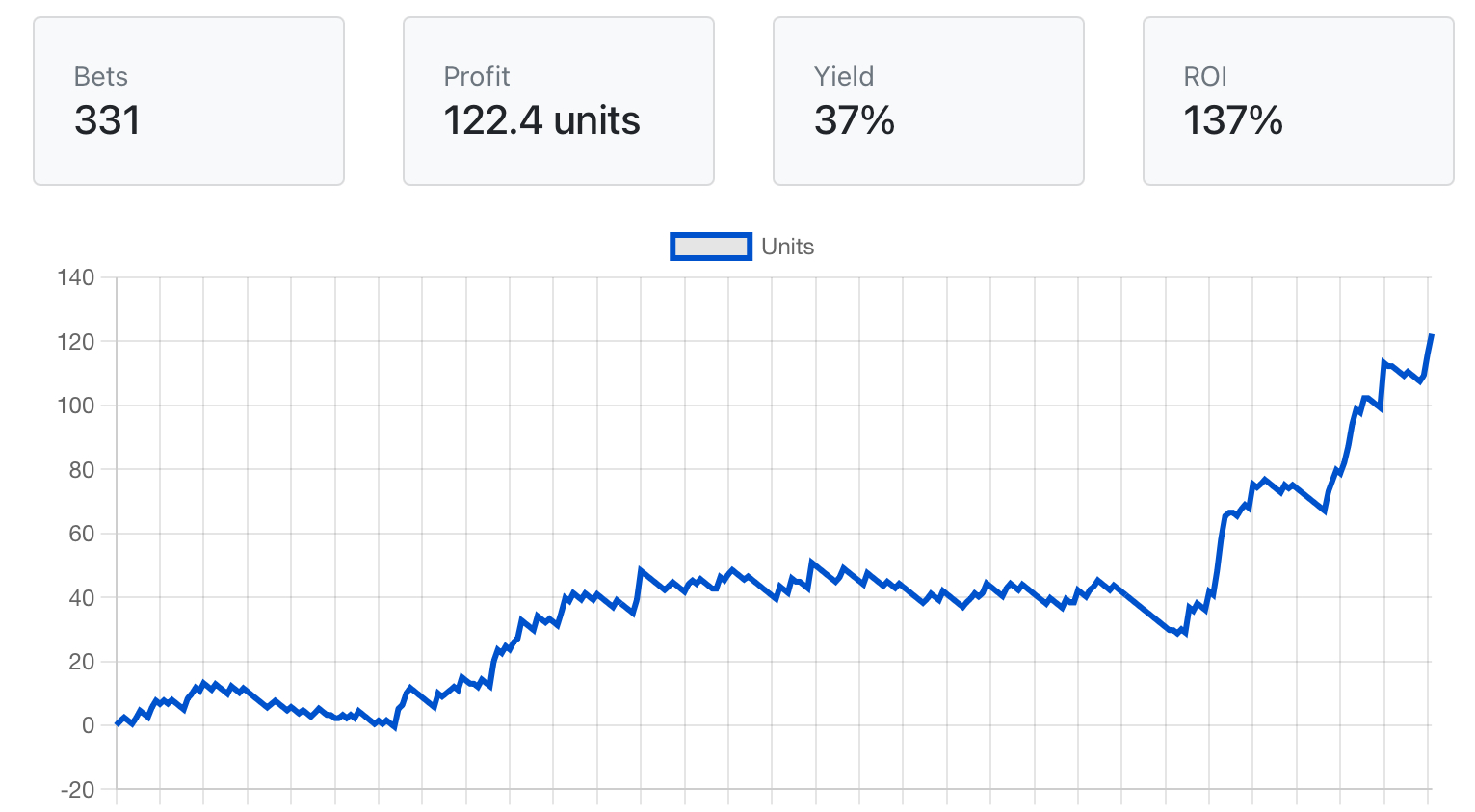


| Profit (units) | Yield (%) | Strike Rate (%) | Average Odds (Decimal) | Illustrative Return (£100 staked per pick) |
| +133.70 | 35.40 | 33.70 | 5.09 | £13,370 from backing every selection as of April 2026 |
How Bookmakers Work – Traders, Limits & Profit
According to the latest industry statistics published by the UK Gambling Commission, the total gross gambling yield of the Great Britain gambling industry equalled £12.6 billion for the twelve months between October 2014 and September 2015. Those self-same statistics also revealed the presence of 8,809 betting shops in Britain, which account for the lion’s share of the over 100,000 people employed within the industry. A British Gambling Prevalence survey in 2010, too, revealed that an estimated 22% of the British population regularly engage in betting on horse racing and approximately 12% bet regularly on other sports. Discover How Bookmakers Work with Tennis Tips UK
What all of that tells us is that bookmaking is, without question, big business. The fact that bookmaking is indeed a business is an important realisation, moreover, as it is something which often escapes the notice of punters. Bookmakers, after all, are in the game to make a profit not to engage in gambling and the way they run their businesses definitively reflects this. With that in mind, it is important for any punters to understand exactly how bookmaking works and how it is weighted to give bookmakers a profit making edge.

How Bookmakers Work – Traders, Limits & Profit | Gambling has grown exponentially in the past decade
Making the Book – The Theory
The term ‘bookmaking’ originates from the practice of taking bets on a given event and recording those wagers in a ledger known as the ‘book’. Original bookmakers, therefore, would literally make a book for each event by deciding upon the odds they would offer for different outcomes and recording who bet what at which odds. Today, the situation is in theory fairly similar but has significant wrinkles which most punters are simply not aware of.
It is a fairly widely held misconception that bookmakers set odds by analysing events, deciding upon the probability of each outcome in the event and offering odds which directly reflect those probabilities. That is quite simply not the case, however, as the following explanation of the theory and mathematics of bookmaking should make abundantly clear.
Firstly, it is important to state that bookmakers do indeed use a wide range of information and data to determine the relative probability of different outcomes occurring in any given event. That is only the beginning of the process of making a book, however, and there are a number of further steps taken. As a starting point, though, it does mean that understanding how you can reach specific odds from those initial relative probabilities is important to understand.
The best way in which to explain this is through an example. Say, for instance, that in a tennis match the bookmakers determine that the relative probabilities of each player winning are 60% (0.6) and 40% (0.4). In that case the odds which those probabilities suggest, can be determined by the following calculation:
(1-X)/X, when X = the probability
In our example, the odds of the first player winning would be calculated thus; (1 – 0.6)/0.6. Those odds, then, would be 0.4/0.6 which would be expressed in a betting shop or online as 4/6. For the second player, meanwhile, the calculation would be (1 – 0.4)/0.4 which gives odds of 0.6/0.4 or 6/4.
If bookmakers, therefore, were to offer odds of 4/6 and 6/4 on our tennis match it would be what is known as a ‘fair book’ as the probabilities which the odds represent add up to exactly 100%. As we have mentioned, however, bookmakers offer odds in order to make a profit and as such those are not odds which they would provide to punters. Instead, they would proportionally reduce those odds so that they still reflect the same relative probability of the outcomes occurring but are weighted more in the bookmaker’s favour.
In our example, for instance, bookmakers may actually offer odds of 1/9 and 4/6 for the two players in our tennis match. Those odds are in the same proportions as regards their relative probabilities but if you reverse our above calculations you find that these probabilities do not add up to 100%. In fact, odds of 1/9 and 4/6 give you relative probabilities of 0.9 (90%) and 0.6 (60%), meaning that this book produces a total of 150%.
The amount by which a book does exceed 100%, is known as its ‘Overround’ or as the bookmaker’s ‘Margin’ or ‘Vig’. It is this which determines that in theory the bookmaker will always make a profit (and in this case a 50% profit) no matter the outcome of the event. Once again, this is most easily demonstrated by following through our example and assuming that the bookmaker takes bets in proportion to the true probability of each outcome occurring.
For our tennis match example, therefore, if the bookmaker were to take £90 worth of bets on the first player and £60 worth of bets on the second player at the advertised odds of 1/9 and 4/6 they would receive £150 worth of stakes. Regardless of who wins in that scenario, they would only ever pay out £100, however, as a £90 winning bet at 1/9 returns £10 plus stake and a £60 winning bet at 4/6 returns £40 plus stake. The bookmaker, then, has set the odds to ensure that they will make a 50% profit from the event.
This is of course how the process works in theory and in practice there are other considerations, including the possibility that punters do not bet exactly in proportion with probability, but it is a good model for explaining how bookmakers ensure an edge. What’s more, bookmakers are the only people well enough placed to account for those practical variations in betting and they routinely alter their offered odds accordingly.
The above, then, provides a stark representation of how bookmakers set odds to ensure that they are profitable in the case of single bets. When it comes to multiples, too, things by no means get any better for punters.
Compounding The Bookmaker Edge
In the case of multiple bets, bookmakers implement the same process of setting odds but with one notable difference. That difference is that the odds offered to punters are compounded in such a way as to be to their detriment and to the benefit of the bookmaker.
In order to demonstrate this, let’s assume we are going to bet on two tennis matches where the actual relative probability of either player winning is 50%. The true odds for each player, therefore, would be evens (1/1) but as explained above what may be offered to punters could be more like 5/6. By applying the calculation explained earlier, then, we would find that the bookmaker’s overround on each match in this case would be 9.09%.
If a punter were to bet on the outcome of the two matches as a double, the overround of that double can be calculated using the following equation, where A is the overround of the first match’s book and B is the overround of the second :
Double’s Overround = A x B x 100 – 100
In our scenario, then, the calculation would be 1.0909 x 1.0909 x 100 – 100 = 19.01%. That means that for the double the overround would be 19.01%, which is more than double the overround for the two singles. That enhancement in the bookmaker’s margin increases almost exponentially as further selections are added to multiple bets and is the reason why bookmakers are so keen to encourage punters to place such wagers.
For both singles and multiples, therefore, bookmakers set odds in such a way to ensure that in the long term it is always they who come out on top. One might think that this was enough for them to ensure their profit making potential, but the fact is that most bookmakers also have another trick up their sleeve.
Limiting, Restricting and Closing Accounts
The way in which bookmakers work is aimed at ensuring that they can make a long term profit, and as such this makes it very difficult for punters to do the same. On some rare occasions, however, punters do get themselves in the black and when this happens bookmakers have become increasingly swift and harsh in their response.
In the past few months and years, reports of bookmakers restricting the activity of profitable punters or even of closing their accounts have become more and more widespread. Numerous media reports and investigations, in fact, have found the practice to be prevalent throughout the bookmaking industry.
A BBC 5 Live investigation in late 2015, for instance, revealed a huge number of examples of bookmakers closing profitable online accounts and also lifted the lid on the attitude of betting shops toward successful punters. A betting shop manager who spoke to the BBC revealed how the unnamed company who he worked for felt about gamblers who made money:
‘If they are a serious backer of horses and clearly know what they are doing with the odds then we don’t want them at all.’
If that sounds to you like it is unfair and morally questionable, then you are not alone and a number of notable figures – including former Scottish First Minister Alex Salmond – have already said the same. The problem, however, is that the practice is in no way illegal as all bookmakers without fail stipulate within their terms and conditions that they have the right to refuse the business of anyone they wish and at any time they choose.
That gets to the heart of the issue, therefore, as bookmakers are both the ultimate arbiters of gambling and those who set the rules of the game in the first place. In that scenario, then, and with their ultimate aim being to ensure their own profitability it is obvious that in the long term the house will always win. That’s why Tennis Tips UK recommend sports betting exchanges for club members in almost all cases.
How Bookmakers Work Infographic:

How Bookmakers Work | Tennis Tips UK Animated Graphic
Share this ‘How Bookmakers Work’ Graphic On Your Site
 TENNIS TIPS UK Club Membership – How it Works
Follow @TennisTipsUKSynopsis: A private betting club where members receive regular betting picks direct to their email inbox. This clearly states the match, specific bet and advised stake. There is a ‘best bet’ which is the highest value selection our team has found across all markets. This is exclusively available through the club membership. Club members should expect to receive 1-2 bets per week on average.
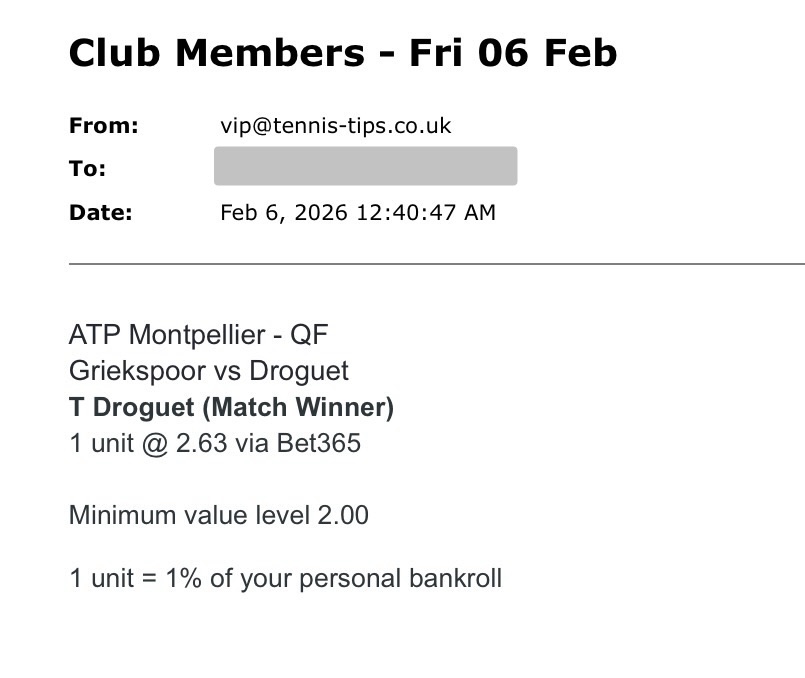
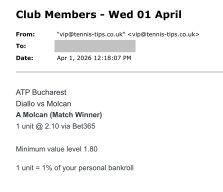
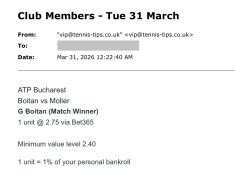
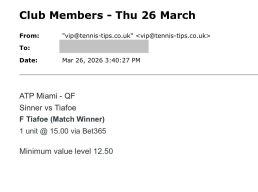
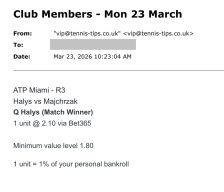
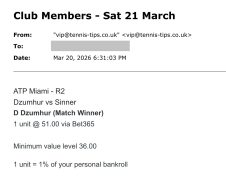
Who picks the advised bets?Tennis Tips UK have a team of analysts built over the past decade. Each has shown a proficiency in beating ATP, Challenger or Grand Slam markets consistently. See an example of the email format members receive below. To make the service more practical to follow we send out picks around 6 hours before the scheduled start time on average so it should be feasible to follow regardless of client timezone.
Odds sourced from Bet365 as they are the most used betting portal worldwide. Match winner (moneyline) markets used so practical to follow with any bookmaker. Those with access to an exchange account are likely to comfortably exceed the recorded profit figures even after commission is deducted so this is highly recommended.How much profit have the picks made overall?
As of late 2025; a £100 bettor has enjoyed profits in excess of £10,000 assuming they backed the quoted price. Please note the image below is updated once annually – see the link below for the most up to date performance figures.
Full tracking is available publicly via a third party verification platform.How do you profit from tennis betting?There is no single ‘one size fits all’ approach. Tennis Tips UK have been fine tuning the selection process since way back in 2013. For a comprehensive insight into our thesis try exploring our tennis betting research articles.
I’m looking for a more hands-on approach, what do you recommend?Some punters prefer to actively select or trade their own markets. The same thesis as before regarding compounding can still apply in this situation but crucially you’ll need to be able to find and back value bets yourself. There are advanced tools that let you identify +EV bets, see where sharp money is betting and apply complex filters to find markets that meet your criteria.
What about responsible gambling?All forms of sports betting, including club picks, need to follow strict responsible gambling principles. The crucial one – never bet with funds that you can’t afford to lose. This means the assigned bankroll needs to be surplus to requirements. Adopting a long term, investment style approach as described previously will put you on the right path but this never replaces the ten golden rules of responsible gambling.
Do I need to be in the United Kingdom (UK) to join the private betting club?No. Tennis Tips UK are based and operated by a team in England, hence the name, however we have clients from all over the world in the club. The membership fee is paid in GBP (£) in most cases however our checkout page has a feature called ‘adaptive pricing’ that should let you pay in your local currency such as USD ($) or Euros (€). It’s also possible to pay in British Pounds and let your payment method convert automatically although this may be subject to a modest FX fee.
Am I locked in or committed long term?No all subscribers can access this customer portal after joining. It allows you to cancel your club subscription without any need for input from Tennis Tips UK. Please note in this situation your membership will be terminated at the end of the current billing period. You’ll continue to receive picks for the period paid for but no further payments will be charged. Membership places in the club are limited and your reserved place will be released for someone else in the situation described above.
How will it work after joining?Your membership will be confirmed with a personal welcome email. You’ll get one month of access per payment. You should expect one or two club exclusive pick(s) per week detailing the advised selection, match, tournament and odds. Simply login to your betting account and place a wager on the selected market. We only use standard match winner bets, often referred to as the moneyline, so coverage is extensive at virtually all betting portals.
Have any questions? Please visit the contact us page. Average response time 24h.Is club membership limited?Yes, we allow a maximum of ten members to have an active membership at any one time. This is to preserve value and market liquidity. Essentially ensuring it’s practical to obtain the advised odds without them disappearing too quickly.
What bankroll is required?We suggest £10,000 or more ideally although smaller can work. Most members choose to follow our advice of staking 1% per match. This means it automatically adjusts and scales as the total grows and compounds returns. Some members have vastly exceeded the stated profits by staking higher amounts but please remember to have a long term focus and ensure capacity for successive losses.
What type of bets should I expect?Always match winner (moneyline) bets covering men’s professional tennis. This includes ATP events, Challenger and Grand Slams. Minimum odds 2.00 but the average is around 5.00. We deliver advisory emails at a consistent time around six hours before the scheduled start time to ensure plenty of time to get bets placed.
Who is the club open to?Everyone with a decent bankroll and a long term outlook. We have members from around the world betting in many different currencies and jurisdictions. Tennis Tips UK are based in the United Kingdom, hence the name, but the club is truly global. Please note while the default currency is pounds – the sign up page also permits dollars or euros. These should be presented as an option or automatically switched based on your location. It’s also possible to pay in other currencies using the exchange rate for that day.
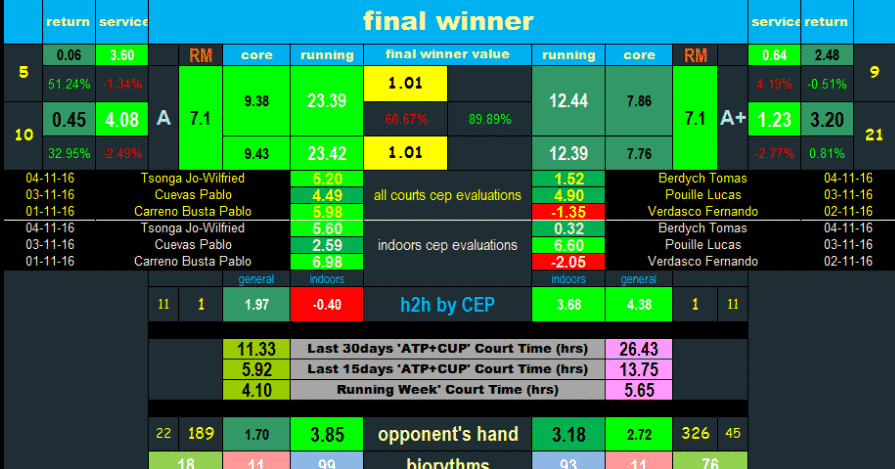
How do you ascertain if a tennis betting market presents value?Since 2013 we have actively built, deployed, maintained and optimised a tennis betting data model. This serves as the foundation of our team’s analysis. We don’t rely on it entirely but it gives a reliable indication as to where the price for a specific player should be. Significant discrepancies between this and actual live market prices across bookmakers and exchanges often flag our attention for further research. The image below shows an old version of our model. We prefer to keep the current iteration private to protect our edge.
Will club bets always win?No. When a specific bet is advised our team are stating there is value in the quoted odds. In other words the true probability of that outcome is higher than the implied figure derived from market odds. Long term backing these bets consistently will deliver considerable profit as our results illustrate. However members should be prepared to lose successive bets frequently as the club focuses on significant underdogs. Sometimes a large percentage of annual returns can come from a single selection.
This is one of the key reasons that the club is now so focused on long term members and making that clear upfront. It was very frustrating to see some join for just a few weeks, lose bets then leave. This benefits nobody. New members should adopt a disciplined bankroll management strategy. The most common is simply staking 1% total bankroll per match. If a handful of consecutive losses would cause terminal bankroll damage then stakes need reducing.How is club performance recorded?For transparency we operate a public spreadsheet. This shows all key metrics such as units profit, ROI, yield and strike rate. We even monitor the Avg Diff CO % for those statisticians amongst you. In a nutshell this measures the implied value by comparing the advised odds with the sharp closing line. Just to clarify bets are only added to the spreadsheet post result confirmation to retain exclusivity of access to paid club members.
For all bets our team also publish profit reports which feature the original email sent to members for additional tracking and verification purposes. This also includes confirmation of the match result and odds proof.Why don’t you bet on your own picks if they are so good?We do, frequently. The issue surrounds liquidity and limitations. Club members have access to a wide range of liquidity from global sportsbooks and exchanges. We, as individuals, are far more restricted. Typically though we still stake an average of £10k per week on our selections but unfortunately virtually every bookmaker has long since banned us. We should take it a compliment really as a limitation is an endorsement of the profitability of your bets from an often billion pound institution.
Why join the club?It offers an investment approach to sports betting that allows disciplined members the ability to gradually grow their bankroll over time. Another key benefit of staking a fixed percentage of bankroll per match is that it scales and crucially compounds returns. Here is an explanation of the concept. This means over time your bankroll can grow exponentially and has resulted in multiple long term club members building pots in excess of £1M. Just remember at this level new challenges present themselves such as trying to get such large stakes accepted or matched but there are solutions out there and of course there is also the option to quit and retire.