
Use these research articles, charts and a downloadable worksheet to inspect the evidence behind tennis betting advice. The resources are public and do not require a membership or email address. Start with the explanation beside each calculation: a reusable graphic is useful only when its assumptions and limitations remain clear.
Featured comparison: which sport suits following tipsters?
Our comparison of tennis, football, racing, basketball and cricket separates a plausible research advantage from advice a follower can execute. It includes a sport-by-sport table, a price-execution calculation and the evidence behind our conditional preference for selective tennis research. The comparison is an editorial assessment, not a measured league table of sport profitability.
Download the price-execution graphic and data
The original illustration asks a simple question: what changes when a follower obtains worse odds? It assumes a 50% win probability throughout. An illustrative commission of 2% applies to winnings on an isolated bet. At odds of 2.10 the expected return after that commission is +3.90%; at 1.95 it is −3.45%. These are stipulated inputs and calculations, not observed match results or a tipster backtest.
- Download the original SVG chart
- Download the calculation table as CSV
- Copy the chart embed and read its assumptions
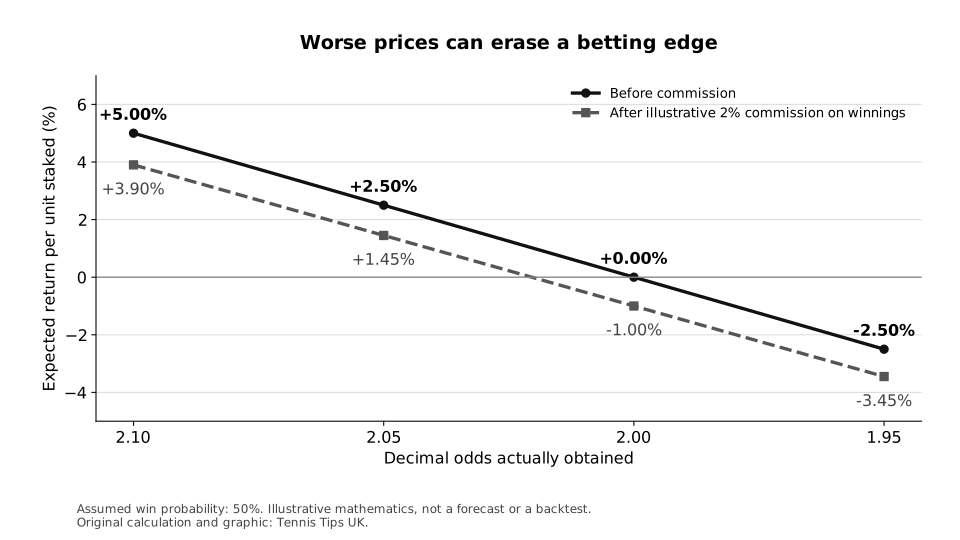
The article explains the formula, charges and exclusions. Actual prices, settlement rules and account terms can differ. Any quotation or reproduction should preserve those distinctions.
A worksheet for evaluating advice
Download the blank tipster-evaluation worksheet (CSV). Open it in a spreadsheet and keep one row per recorded recommendation. It is a simple documentation template, not a model or prediction service.
Record the advised price separately from the price you obtained. Keep missed recommendations in the log, marked as not placed, rather than silently selecting a favourable subset. Include the precise market, stake convention, applicable rules and result source. Use your own references; avoid storing account credentials or other people’s private details.
- Record the recommendation and publication time before inspecting its result.
- Record the execution time, accepted odds and stake independently of the advised values.
- Mark the settlement as won, lost, void, pending or not placed; do not treat an unplaced bet as a betting loss.
- Enter the actual net result and costs separately, using consistent currency and unit conventions.
- Review all rows together, including missed opportunities and losses. A short profitable sample does not establish a durable advantage.
For definitions and interpretation, use the tennis-tipster assessment guide, settlement-rules guide and units and bankroll guide. The worksheet does not recommend a stake size.
Find the research behind a claim
| Question | Resource | What to retain when citing it |
|---|---|---|
| Do closing prices show an edge? | Closing line value research | Market, margin method, timestamps and limits of the benchmark. |
| Does head-to-head history add information? | Head-to-head evidence review | Sample size, surface, date coverage and comparison with available odds. |
| Which metrics can identify value? | Tennis metrics and value research | Source attribution, uncertainty and whether findings concern prediction or realised returns. |
Citing and sharing responsibly
A useful citation identifies Tennis Tips UK, the exact article title, publication date and URL. Link to the article rather than an isolated graphic when readers need its methods. The existing embed controls include visible brand attribution and no scripts or visitor tracking. Editors may qualify citation links with rel="nofollow"; a followed backlink is not a condition of chart reuse.
Keep third-party research credited to its original authors. Our chart downloads are not releases of those authors’ full underlying datasets. Publisher-reported results, original illustrative mathematics and the club’s selected betting record are different kinds of evidence and should remain labelled accordingly. No citation should imply an endorsement or a guaranteed financial outcome.
For adults where betting is legal. Research is educational; choosing not to bet remains an option. See the research hub for the full articles and their sources.