
Tennis Tips UK · Research & reports
Which sport is best for following tipsters—and finding a betting edge?
Published October 14, 2026
That is a case for suitability, not a claim that tennis produces the highest profits. There is no reliable, like-for-like evidence in the research reviewed here that ranks tennis, football, horse racing, basketball and cricket by the profits an ordinary tipster follower can achieve. The sport creates the setting; the quality of the advice, available odds and execution determine whether a particular service has value.
This comparison answers two linked questions. Which sport lends itself to finding an edge beyond the odds? And which makes that edge practical to follow? The answers can differ. A knowledgeable analyst may identify an attractive price that disappears before subscribers can place a bet. Equally, an easy-to-follow service may provide selections with no demonstrated advantage over the market.
Our conclusion favours tennis for someone seeking selective pre-match advice, a defined research focus and a transparent record. A football, racing, basketball or cricket specialist with stronger evidence and more attainable prices could still be the better choice. The decision should survive that comparison.
1. What “best sport for tipsters” should actually mean
A useful comparison starts with the requirements of the person following the tips. A follower needs an exact selection, a clearly defined market, a price that remains available, an affordable staking approach and a record that includes losses. A persuasive explanation after a match cannot substitute for those requirements before it.
We assess each sport against five questions:
- Research: Can a specialist form estimates that improve on information already reflected in the odds?
- Price: Are the offered odds high enough for that estimated advantage to survive margin and commission?
- Execution: Can followers obtain comparable prices at their intended stakes, without relying on unrealistic speed or exceptional access?
- Measurement: Can the service document every selection and settlement consistently, including voids, price changes and losing runs?
- Practical fit: Does the schedule and volume suit a person following advice rather than continuously trading a market?
These are editorial criteria, not a statistical league table. We have not assigned invented scores, surveyed every tipster or conducted a new cross-sport betting experiment. A sport with more observable variables does not automatically offer more mispricing. A sport that is simpler to describe is not automatically easier to beat.
There is also a distinction between a sport and a market. Football match results, Asian handicaps and player shots are different products. Horse-racing win and each-way bets have different payoff structures. Basketball moneylines, spreads and player points require different evaluations. “Tennis” in our main comparison means singles pre-match match-winner betting, not every set, game or live market available.
2. The comparison at a glance
Table 1. Practical suitability for following a specialist. The assessments are reasoned judgements, not measured profit rankings.
| Sport and main market | What makes specialist research plausible? | Main obstacle for followers | What a credible record must show | Our conditional verdict |
|---|---|---|---|---|
| Tennis: singles match winner | Surface, serve and return, opponent style and workload can be studied at player level | Retirement terms, uncertain fitness, rapid price changes and uneven liquidity | Exact player and event, attainable odds, stake, settlement and all losses | Our preferred focus for selective pre-match tipping, if price and record tests pass |
| Football: match result and related markets | League specialisation, team strengths, lineups and tactical context | Popular matches attract close attention; the exact market and timing matter | Competition, market, selection, price and treatment of draws or abandoned matches | Strong alternative for a genuinely narrow specialist with reproducible prices |
| Horse racing: win or each-way | Pace, ground, distance, race conditions and individual runners | Multi-runner uncertainty, non-runners, deductions and changing place terms | Original terms, each-way stake convention, deductions and settled returns | Suits experienced followers who can audit the full payoff structure |
| Basketball: moneyline or spread | Player availability, rotations, matchup and schedule context | Late news, movement in both price and handicap, high-volume demands | Exact line as well as odds, timestamp, push treatment and stake | Attractive for timely specialists; less convenient when the edge requires immediate action |
| Cricket: format-specific match winner | Venue, conditions, roles and format-specific team strength | Weather, toss, team changes and differing competition rules | Format, market, timing, interruption terms and actual settlement | Good fit for a format expert whose advice remains actionable after relevant news |
The table points towards tennis because it offers a coherent research unit: two players, a surface, a match format and a quoted price. It also makes clear why choosing tennis alone is insufficient. If the recommended odds cannot be obtained, or the record excludes losing selections, that coherence has little practical value.
3. What counts as a profitable betting edge?
For a fully settled win-or-lose bet, an edge means the expected net return is positive at the odds actually available. It does not mean that the selection is likely to win, or that the tipster is more knowledgeable than the follower.
At decimal odds of 2.00, a selection needs a win probability above 50% to have positive expected value before other costs. At 1.50, the break-even probability is about 66.67%. At 3.00, it is about 33.33%. Selecting more winners can therefore coexist with losing money: 65 wins from 100 equal stakes at 1.50 returns 97.5 units against 100 staked, a loss of 2.5 units.
For the simple case, expected return per unit staked is estimated probability × decimal odds − 1. The important word is estimated. Nobody observes a match’s true probability directly. A model may be confidently wrong; a market may already incorporate the analyst’s insight; an attractive result over a short sample may be chance.
Bookmaker prices also include a margin. Adding the reciprocals of all mutually exclusive outcome prices gives an overround calculation. Normalising those reciprocals can be a useful market benchmark, but it does not reveal unquestionable true probabilities. Different margin-removal assumptions can produce different estimates, especially away from even money. Treat the market as a demanding reference point, not an oracle.
The same logic applies across sports. A highly accurate tennis forecast can have no value at a short price. A football underdog can offer value while still being more likely to lose. An outsider in a race is not value simply because the potential payout is large. The relevant question is whether the price compensates for the chance of losing.
A tipster’s edge and a follower’s edge are different
Consider an illustrative selection with an assumed 50% chance of winning. This probability is stipulated for the example, not measured from a real match. At 2.10 the gross expected return is +5%. At 2.00 it is zero. At 1.95 it is −2.5%. Nothing about the player or team has changed; only the follower’s price has changed.
Table 2. Original illustrative calculation: expected return at an assumed 50% win probability. Commission is assumed to be 2% of winnings on this isolated bet, not a statement of any provider’s current rate.
| Decimal odds obtained | Gross expected return | Effective odds after illustrative commission | Expected return after that commission |
|---|---|---|---|
| 2.10 | +5.00% | 2.078 | +3.90% |
| 2.05 | +2.50% | 2.029 | +1.45% |
| 2.00 | 0.00% | 1.980 | −1.00% |
| 1.95 | −2.50% | 1.931 | −3.45% |
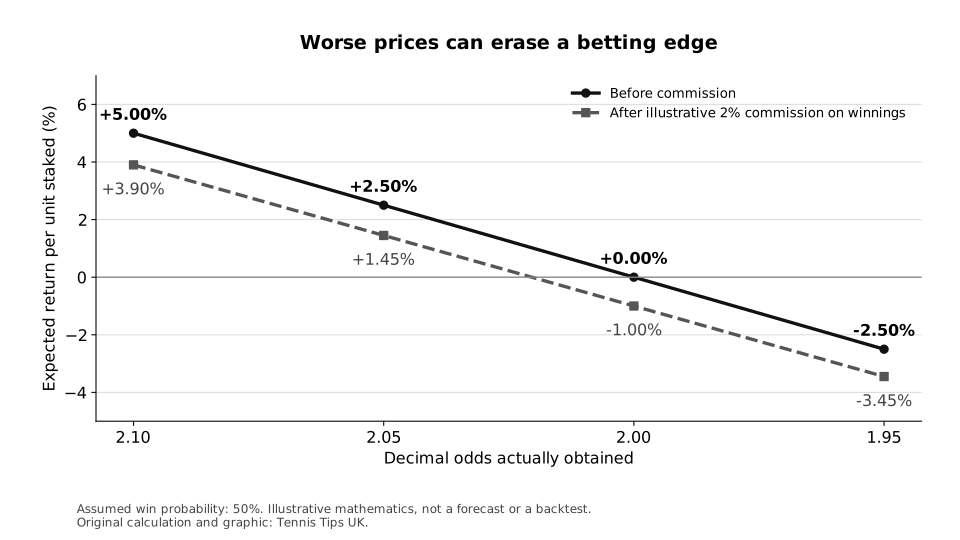
Actual exchange commission may depend on net market winnings and account terms. Bookmaker bets have different charging structures. The example excludes voids, partial settlements, tax and service costs. Its purpose is narrower: to show that small price differences can change the sign of an edge.
That is why an honest service should make the recommended price, acceptable minimum price and publication time clear where applicable. Followers should compare their actual prices with the published record. If a service reports a profitable month at odds its audience rarely obtains, the audience needs its own result calculation.
4. Why tennis makes a particularly strong case
A defined contest, with fewer layers between the analysis and the selection
In singles tennis, one player competes against another. Completed standard matches have a winner rather than a normal draw outcome; the ITF rules define how games, sets and matches are won.[1] That gives the match-winner market a clean starting point for explaining a tip.
It does not make the probability estimation easy. Both players bring uncertain form, fitness and tactical choices, and the environment still matters. However, a follower can usually identify exactly what has been recommended without untangling a team’s starting eleven, multiple runners or an each-way place component. The selection can remain the same straightforward market across a service’s record.
Retirement, walkover and interruption rules remain essential. Two operators can treat an unfinished match differently. A two-player contest should never be confused with a bet that is guaranteed to settle as a simple win or loss. Our tennis betting rules guide explains why terms and net payout need to be checked.
Surface gives specialisation a clear purpose
A player’s overall ranking is an incomplete description of how that player may perform in a particular environment. A specialist can ask how serve and return performance, movement and rally patterns translate to the surface and opponent in front of them.
The useful question is specific: does a surface-related estimate add information beyond the current price? “This player likes clay” is too loose. A defensible analysis needs an appropriate sample, opponent adjustment, recency and uncertainty. A few wins in one tournament may say more about the draw than about a durable surface advantage.
This is an attractive research setting because hypotheses can be stated clearly and tested repeatedly. For example, a surface-adjusted estimate can be compared with a simpler rating and with the market on later matches. If the extra detail improves neither calibration nor attainable returns, the specialist should reconsider its value. The appeal is the ability to build and scrutinise expertise, not permission to assume every surface narrative creates value.
Serve and return provide a natural structure for analysing a matchup
Tennis separates serving and returning roles within the same contest. That encourages questions about the interaction of two players rather than a general claim that one is “in good form”. The quality of opponents, the surface and the stability of the sample all need consideration.
A strong server’s statistics against weak returners do not automatically transfer to an elite returner. A recent run of breaks may reflect opposition or a temporary streak. Point-level observations can also be dependent: a large number of points is not the same as a large number of independent matches.
For a follower, the benefit is explanatory discipline. A specialist can describe why a matchup merits examination while still acknowledging what the evidence cannot establish. Our research on tennis metrics examines that distinction in more detail.
Repeated opponents and contrasting styles support focused learning
A singles specialist can follow players over time and compare how their games interact with different opponents. That creates a coherent research programme: review a hypothesis, observe later matches, and check whether the assessment remained useful.
Head-to-head records require caution. Two old meetings do not establish a reliable advantage. Changes in fitness, surface or career stage can make previous scores a poor guide. Even a genuine stylistic interaction may already be priced in.
Recent work by Clegg and Cartlidge studies intransitive relationships—situations in which player A beats B, B beats C and C beats A. The current author abstract reports complementary forecasting information beyond a rating benchmark; Bristol lists the paper as accepted/in press on 10 October 2026.[2] This supports examining matchup structure. It does not establish a profitable tipping service or tell followers what odds they can obtain. The revised paper’s focus is forecasting, and improved prediction against a rating model is a different claim from beating betting prices.
A selective service can be practical to follow
Pre-match singles selections can suit someone who wants a small shortlist rather than a stream of live trading instructions. A clear player, event, stake and price is relatively easy to record and review. Selecting fewer bets also reduces the operational burden of checking markets and reconciling settlements.
Low volume is not evidence of quality in itself. It can slow the accumulation of evidence, and followers still need to act before the match and respect price limits. Time zones and moving start times can make execution inconvenient. A service should explain its delivery process rather than imply that every subscriber can always reproduce its record.
For Tennis Tips UK, the current focus is around two English pre-match moneyline picks per week, using a proprietary data model refined since 2013 alongside human review of a shortlist. The supplied public record begins in January 2024. That describes our approach; it does not turn process history into a longer tracked performance record or prove future returns. Read how we select tennis picks and the complete results record together.
5. The strongest objections to choosing tennis
Fitness uncertainty can overwhelm a good statistical comparison
One player’s physical condition can change a match assessment sharply. Public information can be incomplete, and signs noticed during play may arrive too late for a pre-match bet. A detailed statistical model does not eliminate uncertainty about health or an unfinished match.
A responsible analyst should distinguish a verified report from speculation. A follower should know which retirement rules apply and avoid assuming that a bet’s settlement will mirror the official sporting result. Claims of special knowledge need particular scrutiny.
Lower-profile markets are not automatically easier money
ATP, WTA, Challenger and ITF events can differ in available data and the ease of obtaining a stake at a particular price. A less prominent match may present a research opportunity, but it may also have weaker information, less dependable market depth and faster deterioration of an attractive quote.
An apparent inefficiency that only supports a tiny stake or vanishes on publication may have limited value to a service with many followers. The capacity of an edge matters. The right response is to test price availability, not to assume that less coverage means a larger profit opportunity.
Underdogs and favourites both need price discipline
Long odds make wins memorable, while short odds can make a service look consistently accurate. Neither provides a sound selection rule on its own.
Hegarty and Whelan examine 84,230 football matches and 55,988 ATP/WTA matches using historical average closing odds. Their analysis identifies favourite–longshot bias, but the examined odds groups still lose money on average; relatively better returns do not establish a profitable blanket strategy.[3] These are broad historical market samples, not a controlled test of today’s tipsters. They argue against the simplistic idea that betting all tennis favourites or all underdogs is enough.
The lesson for our tennis case is demanding: player-level specialisation must justify the individual price. It cannot rely on an attractive sport-wide slogan.
6. Football: an excellent alternative, with a different research burden
Football gives specialists many possible areas of focus: one league, a team-strength model, a particular handicap market or a narrowly defined type of match. A follower familiar with the competition may also find it easier to check the reasoning and the match details.
The complexity lies in separating relevant information from what is already expected. Team selection, player roles and tactical changes can alter the assessment. A specialist following one league may understand those interactions well, but that knowledge has to improve on the quoted price. Recognising that a leading player is absent is not an edge if the market has already adjusted sufficiently.
The standard match-result market includes the draw. Under IFAB’s laws, equal scores can constitute a drawn match, with competition rules determining any permitted procedure to establish a winner.[4] A bet on the result after normal time is different from a bet on qualification or a winner including extra time. The follower must compare like with like.
A classic study by Spann and Skiera compared tipsters, prediction markets and odds across three German league seasons. Its abstract reports that market-based forecasts outperformed the tipsters studied, and that high charges prevented systematic gains in the particular betting setting.[5] This old study does not determine which current service to choose or describe current market-wide margins. It does show why football knowledge and confident selections should not be treated as evidence of profitable forecasting.
When football may be the better choice: the specialist has a strong, complete record in a market the follower understands; prices remain available; and the delivery schedule fits the follower’s routine. A tested football specialist is preferable to an untested tennis generalist. Our preference for tennis rests on the suitability of focused singles research, not a dismissal of football expertise.
7. Horse racing: rich information, more complicated execution
Horse racing can reward deep familiarity with runners, race conditions, ground, distance and how a race may unfold. A specialist can form a view about a runner that a casual reader would struggle to assess. This is a legitimate reason to consider a racing tipster.
The follower’s task can be more demanding. A win bet asks one runner to beat a field. An each-way recommendation combines a win component and a place component; the number of places, fraction of win odds and stake convention change the payoff. A “one-unit each-way” instruction should state whether it means one unit on each component or one unit in total.
Non-runners and deductions can change the realised price. Promotional place terms can also make two apparently identical selections different bets. A credible result log must use the terms actually available and account for the settlement, rather than presenting an undeducted headline price after the fact. There is no single universal set of operator terms to assume.
Snowberg and Wolfers’ horse-racing research examines favourite–longshot bias and finds evidence consistent with probability misperception.[6] Its particular racing data and pool-betting context should not be translated into a current ranking of UK fixed-odds tipsters. The broader warning is useful: attraction to large payouts can distort judgement, and identifying a behavioural pattern does not automatically provide a net-profit strategy.
When racing may be the better choice: the follower understands settlement and each-way terms, can obtain the relevant prices and has evidence of a specialist’s performance after deductions. For someone seeking a simple, consistent match-winner service, tennis offers a more straightforward product to audit. For a knowledgeable racing follower, that simplicity may be less important than a proven racing specialism.
8. Basketball: data-rich analysis, but news and lines matter
Basketball offers structured questions about player availability, rotations, matchups and schedule context. A specialist can examine how a change in personnel affects a team’s expected performance rather than relying on a headline season average.
News is also a shared input. Official NBA injury reporting demonstrates that participation information is formally reported and updated; the cited 2025–26 page describes that season’s requirements.[7] A public update does not automatically favour a tipster over an operator. The advantage, if any, must come from interpreting the information better, valuing it more accurately or acting at a price the market has not fully adjusted.
For followers, the exact line is critical. A recommendation at one points handicap is not equivalent to a later recommendation on the same team at a different handicap. A service should record both the odds and the line, including how pushes and other settlements are treated. A profitable spread record cannot be reproduced merely by backing the same side at whatever number remains.
Volume creates another practical question. A busy service can demand frequent attention, particularly when important updates arrive near game time. That may suit an active follower; it may be a poor fit for someone who wants to read an email and place occasional pre-match bets. The volume also creates opportunities to select flattering time periods, so the full sequence matters.
When basketball may be the better choice: the tipster has a narrowly defined, tested market, clear line and price limits, and evidence that followers can act in time. Tennis has an advantage in our comparison for a selective, single-market service; basketball can be equally coherent when its specialist and follower share an appropriate workflow.
9. Cricket: format expertise and changing conditions
Cricket should not be treated as one uniform modelling task. Test cricket and limited-overs formats create different contests, and conditions, team roles and the stage of a match can affect which information is relevant.
A format specialist may understand a venue, a bowling attack or a batting order in a way that adds useful forecasting detail. The same test still applies: does that detail improve on what the market already knows? A familiar explanation about a pitch is not enough unless it changes the estimated chance of an outcome relative to the price.
Weather and interruptions add a further layer. The ICC explains that the Duckworth–Lewis–Stern method is used to recalculate targets when weather interrupts limited-overs matches.[8] The playing conditions and the operator’s settlement terms are separate things. A follower needs to know how the particular bet treats interruptions, ties or a match that cannot produce the expected result.
The toss and final team information also create timing decisions. A service recommending a selection before relevant information becomes known should explain the uncertainty. A service acting afterwards needs to show that its price remains obtainable. A good forecast released at an impractical moment is a weak product for followers, even if the analyst is skilled.
When cricket may be the better choice: the specialist has evidence in a clearly defined format and market, with a delivery process that handles relevant news and settlement. Tennis is our preferred general focus for a selective singles service, while cricket can suit followers with the time and understanding to manage its particular conditions.
10. Which sport offers the greatest scope for an edge?
The strongest answer is a well-defined market where a particular specialist can demonstrate additional information and practical execution. The unit of comparison should be the tested process, not the name of the sport.
An analyst might have a sound surface-adjusted tennis method, a useful football lineup assessment or expertise in a particular kind of race. Each is a plausible research direction. None becomes an edge until it improves decisions at available odds. The less obvious information may be harder to measure reliably; the better price may support less money; the more sophisticated model may overfit its historical sample.
Tennis deserves a strong position because it combines a clear contest with several meaningful, testable dimensions. A specialist can focus on the interaction of two players, adjust for environment and compare a forecast with the market. That structure makes it a particularly appealing place to build disciplined expertise.
But the available evidence does not establish a universal “tennis profits more than football” result. Cross-sport comparisons can be distorted by sample periods, average odds, staking, operator access and which services survive long enough to be observed. Comparing the best surviving tennis record with an average racing service would be unfair. Comparing maximum recorded odds in one sport with ordinary follower prices in another would be unfair too.
An edge also changes over time. If a useful approach becomes widely known or a service’s audience grows, prices may adjust sooner. A record should therefore be reviewed prospectively, with methods and evaluation periods chosen before seeing the later results. The confidence to publish uncertainty is a strength in a specialist, not a weakness.
11. How to judge a tipster in any sport
Start with the complete, timestamped record
Ask whether selections were recorded before the event, whether losses and voids remain visible, and whether the advised stake and price are preserved. A screenshot of a winning month is less informative than the full sequence. A third-party proofing link can help establish what was recorded, but does not by itself establish what every follower earned.
Separate sports and markets where possible. If the headline return combines racing, football and tennis, a follower cannot infer that the tennis portion was profitable. The same applies to a record combining match-winner tips and long-odds multiples. Changes in service scope should be disclosed rather than hidden inside a single lifetime percentage.
Calculate returns at attainable prices
Compare recommended prices with prices actually obtained. Record missed selections too, so the assessment does not quietly become a favourable subset. If the tipster gives a minimum price, respect it rather than chasing the same selection after the price moves below it.
Service costs, commission and other applicable costs matter to the follower’s own net result. They should be considered separately and transparently; the headline betting record alone does not establish a personal profit. Increasing stakes to cover costs also increases the amount at risk and cannot turn a negative expectation into a positive one.
Look beyond strike rate and total profit
Yield is net betting profit divided by total amount staked, using a consistent settlement convention. Total profit also depends on turnover and stake size. Drawdown shows the decline from an earlier peak in the running record. Each answers a different question, and none should be replaced with an attractive winner percentage.
Average odds and the distribution of returns matter. A record driven by one exceptional winner is different from one supported by a broad set of smaller returns. That distinction does not invalidate the exceptional winner; it affects how much confidence the record supports. Always examine the losses alongside the wins.
Treat sample size as a question about uncertainty
There is no magic number of bets that verifies a tipster. Dependence between selections, changes in methodology and high-odds outliers affect the evidence. Two hundred selections on related markets are not automatically two hundred independent observations.
Even under an idealised model, profitable observations can remain inconclusive. With an assumed 50% win probability and constant odds of 2.10, the standard deviation of one unit’s return is 1.05 units. For 400 independent, equal-stake bets, a rough normal-approximation interval around the average return has a half-width of about 10.3 percentage points. A model expecting +5% can therefore produce very different observed samples. This is illustrative mathematics, not a confidence interval calculated from a real tipster’s record.
That example also has limits: real prices vary, outcomes may be dependent and the unknown probability must itself be estimated. It explains why a strong conclusion needs more than a profitable chart. It does not give a universal minimum sample or predict a service’s future results.
Use closing prices as supporting evidence
Consistently obtaining better prices than a suitable closing benchmark can provide useful information about execution and market assessment. The comparison needs consistent markets, timestamps and margin treatment. A movement towards a selection is not a guarantee that it will win, and closing prices can be imperfect.
Review closing line value alongside the full return record and the evidence behind the method. Our closing line value research explains the calculation and limitations. Our guide to choosing a tennis tipster turns those questions into a practical assessment.
12. Who is tennis the best fit for?
Table 3. Matching the service to the follower, without predicting a financial outcome.
| Follower’s priority | Why tennis may fit | What still needs checking |
|---|---|---|
| A clear, consistent selection | Singles moneyline advice can use one defined market | Retirement terms and the exact event and player |
| Selective advice rather than constant monitoring | A low-volume pre-match shortlist can reduce operational demands | Timing, time zones and price availability |
| Understanding the research | Player, surface and matchup questions have a coherent structure | Evidence beyond narrative and information already in the odds |
| Auditing a service | Stakes, decimal prices and settlements can be logged consistently | Full losses, attainable prices and honest scope |
| Building knowledge over time | A defined player-level focus supports repeated review | Whether learning improves later decisions rather than hindsight explanations |
Tennis may be a poor fit if the follower cannot check email before a match, cannot obtain the relevant prices, dislikes the uncertainty around retirements, or needs a predictable income. A different sport will not solve the last requirement: betting returns are uncertain in all five sports.
Someone with substantial knowledge of racing or cricket may be better placed to assess a specialist in those areas. Someone who follows a particular football league closely may find that service easier to scrutinise. Choosing tennis should be a reasoned decision about the research and the workflow, not an invitation to ignore stronger evidence elsewhere.
13. Our verdict: make the case for tennis, then test the tipster
Tennis is our preferred sport for a focused, selective pre-match tipping service. Its singles format, surface variation, serving and returning structure and repeated player-level questions provide a strong foundation for specialist research. A consistent match-winner focus can also make the service clearer to follow and its record easier to inspect.
The strongest case concerns how the research and the service fit together. An analyst can investigate a defined matchup; a follower can check the selection and price; the record can retain the outcome without changing market or staking conventions. Those are meaningful advantages.
Finding a profitable edge remains a separate burden of proof. The tipster must add something beyond the market, the price must compensate for uncertainty and costs, and followers must be able to execute the advice. Football, horse racing, basketball and cricket can all support specialist analysis. None—including tennis—offers an automatic route to profit.
For readers considering Tennis Tips UK, start with the complete results, including losses, then read our approach and the research hub. The current Members’ Club explains the service and cancellation terms. The decision should rest on that evidence and your ability to follow the process at affordable stakes, not on a promise of income.
14. Questions readers ask
Is tennis the easiest sport to make money from?
No sport can be described reliably as easy money. Tennis is an attractive setting for focused specialist research and clear singles selections. Profit still depends on the method, available price, costs and uncertainty. The research reviewed here does not establish a universal profitability ranking across sports.
Is following a tipster better than researching bets yourself?
A specialist may save research time and provide a disciplined shortlist. The follower still needs to assess the record, understand the market and obtain an acceptable price. Paying for advice does not transfer the risk or establish that the advice has positive expected value.
Do tennis underdogs offer a better edge than favourites?
Neither group should be backed indiscriminately. A higher payout is not evidence of value, and a higher strike rate is not evidence of profit. The relevant comparison is the estimated chance of winning against the net payout at the available odds.
Does choosing a two-outcome market make betting easier?
It can make the selection easier to explain and record. It does not remove bookmaker margin, improve a forecast automatically or eliminate retirement and settlement complications. Operational simplicity and a profitable edge are different advantages.
Can a profitable tipster still lose money for followers?
Yes. Worse odds, missed selections, different settlement terms, costs or inconsistent staking can change the result. A follower should keep a personal execution record and compare it with the service’s complete advised record.
What is the first thing to check before following a tennis tipster?
Check the complete pre-recorded selections and losses, then check whether the quoted odds remain attainable for you. A credible explanation and an attractive result are useful only when the recommendation can be understood, measured and executed.
Sources and methods
This is an evidence-informed editorial comparison, reviewed on 14 October 2026. It contains no new betting backtest, survey of all services or controlled cross-sport profitability experiment. The comparative suitability judgements are Tennis Tips UK’s analysis. The numerical examples are original illustrative calculations, with assumptions stated; they are not observed returns or predictions. Primary research findings are attributed to their authors and retain their historical scope. Our own linked selection record is publisher-maintained evidence, not a representative experiment across markets or independently measured member income.
- ITF, Rules of Tennis 2026. Sporting scoring rules; operator settlement terms must be checked separately.
- Clegg and Cartlidge, Capturing Intransitive Dominance in Tennis Forecasting. Current author abstract and institutional publication status; arXiv v2, 18 June 2026. The revised scope concerns forecasting complementarity. No obsolete earlier-version betting-profit claim is used here.
- Hegarty and Whelan, Comparing Two Methods for Testing the Efficiency of Sports Betting Markets. Historical soccer and tennis market data and distinctions between market-efficiency tests and profitable betting strategies.
- IFAB, Law 10: determining the outcome of a match. Sporting result rules; individual market definitions remain essential.
- Spann and Skiera, Sports forecasting: a comparison of the forecast accuracy of prediction markets, betting odds and tipsters, Journal of Forecasting, 2009. Findings described from the publisher’s abstract; an older German football setting, not a current all-service comparison.
- Snowberg and Wolfers, Explaining the Favorite–Longshot Bias: Is it Risk-Love or Misperceptions?, Journal of Political Economy, 2010. Horse-racing evidence with its original market context.
- NBA official injury reporting, 2025–26 season. An example of formal public player-status reporting, not a claim about a current player or the next season’s reporting timetable.
- ICC, Duckworth–Lewis–Stern. Target adjustment in interrupted limited-overs cricket; betting settlement is operator-specific.
For adults where betting is legal. Bet only amounts you can afford to lose. Following advice cannot guarantee profit, replace income or recover losses. Choosing not to bet is always an available decision.
See the wider picture.
Read the research alongside the complete results record. See every win and loss and how our proprietary data model and human review select picks.
To interpret prices alongside outcomes, read our research on closing line value. It explains what a market benchmark can show and where it can mislead.
Payment & membership details
Credit and debit cards are accepted through Stripe. PayPal, Apple Pay and Link are also offered where available. Stripe displays the payment options available for your device and country at checkout.
£49.99/month is the base membership price. Stripe may show a local-currency price; check the first payment and renewal amount before subscribing.
All picks and member emails are delivered in English. International members are welcome where betting is legal.
You manage your membership through Stripe and can cancel whenever you choose, without contacting us for approval. Cancellation and refunds are separate.
Member reviews: TipsterCheck ↗ Trustpilot ↗
Maximum 50 paid members. No bookmaker affiliate links. Historical results are before fees and do not guarantee future returns.
Explore tennis betting value and profitability, units and bankroll management, or the tennis picks and results archive.
Follow the record first
Free public result updates.
Follow new public bet reports by email, with their recorded results and occasional membership invitations. Paid pre-match picks are a separate service.
Confirmation required. Unsubscribe at any time. Privacy policy.