
Tennis Tips UK · Research & reports
Is tennis court surface undervalued or overvalued in betting odds?
Published October 16, 2026
Tennis surfaces clearly affect how players perform. But is that difference underpriced, overpriced—or already baked into the odds? Ranking lists combine results from very different courts. A player can be dominant on clay and merely strong on hard courts. Converting that observation into a repeatable betting edge is considerably harder than identifying a surface specialist.
Research verdict: Evidence strongly supports surface-specific player strength; it does not show that bookmakers universally undervalue clay, grass or surface specialists. Peer-reviewed forecasting studies have found both useful surface information and cases where narrower, surface-filtered samples predict worse than broader models. An edge is the difference between a well-calibrated probability and an attainable market price—not a large clay-versus-hard win-rate gap on its own.
Why surface changes a tennis match
Clay, grass and hard courts differ in ball bounce, movement, speed and how points develop. At the player level, those effects interact with return ability, serve quality, movement, tactics and opponent style. A surface adjustment belongs in many tennis models. But a tournament’s conditions also depend on balls, court preparation, weather, altitude and whether play is indoors. “Hard court” is not one uniform environment.
An overall ranking is not itself a match probability. It reflects ranking-point accumulation across events and a ranking calendar. A market-maker is free to use much richer information than the public ranking, including surface-specialist indicators. Comparing a specialist’s results with the ranking alone does not establish bookmaker error.
A published model: the same matchup, different court
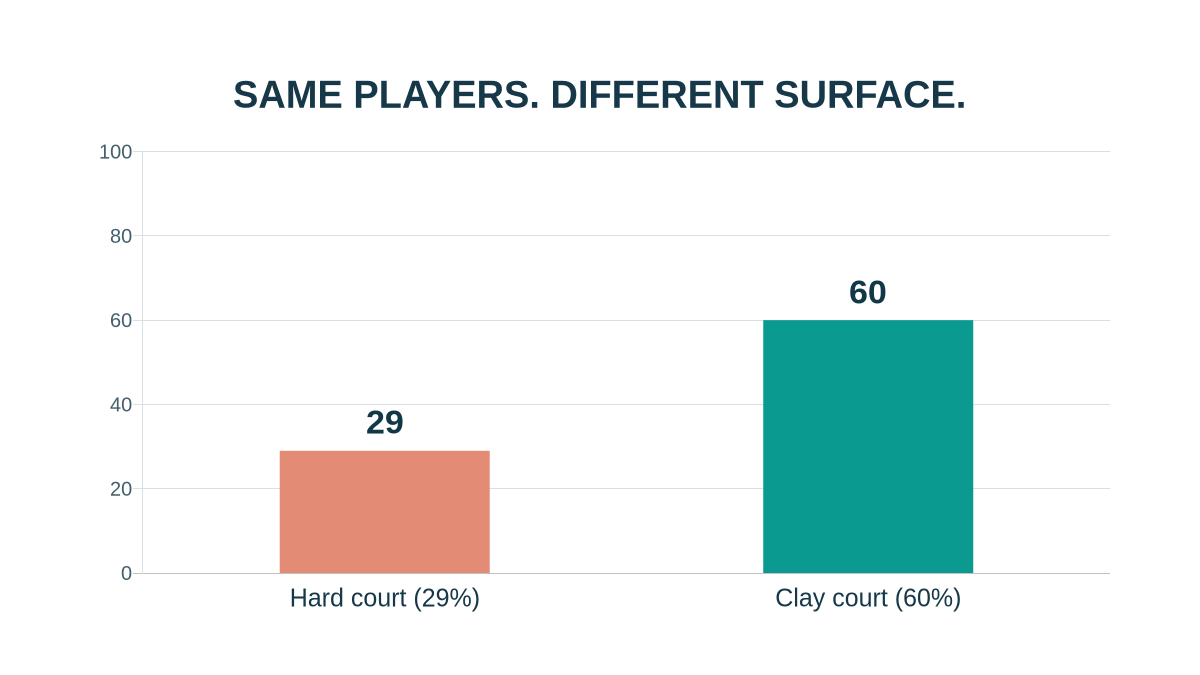
The magnitude here is the point. A strong surface effect can reverse which player a model favours. But it would be incorrect to convert the 2017 example into “always back clay specialists”. The model itself carries uncertainty, court categories hide variation, and market participants can observe the same surface.
What peer-reviewed betting and forecasting research says
Surface can be genuinely predictive
McHale and Morton (International Journal of Forecasting, 2011) developed a tennis-focused Bradley–Terry type model on men’s top-tier matches over 2000–2008. Their results suggested clay was meaningfully different from other surfaces and reported favourable out-of-sample betting returns under their historical model and odds assumptions. That is evidence that some older forecasting configurations found useful information beyond simple rankings, not proof of a persistent present-day price inefficiency.
A separate comparison of tennis forecasting measures examined Grand Slam data across major tournaments and compared rankings, general Elo, surface Elo, blended ratings and bookmaker prices. Betting odds performed relatively well; Elo-based measures were also informative, and models combining signals often did well. The result was not a clean verdict that surface-only predictions always beat the market.
More surface specificity can also make a model worse
A 2026 modelling paper by Wang and Drekic compared tennis forecasting variations including time-window and surface restrictions. In the study’s preliminary comparisons, filtering historical matches by surface reduced classification accuracy in 39 of 48 pairwise comparisons; the authors chose a three-year, non-surface-filtered version for the main analysis. This is not evidence that surface is irrelevant. It illustrates a common trade-off: splitting matches into smaller groups can remove the sample size required for a stable player estimate.
The papers differ in samples, tours, periods and target metrics. We should not pool their percentages or claim that they directly answer a single global market-efficiency question. Their combined lesson is to test whether a surface-specific variable adds predictive information after controlling for the market.
When might surface be under- or overvalued in the odds?
| Scenario | Why a gap might exist | Why it might not |
|---|---|---|
| A genuine clay specialist faces a stronger-ranked all-rounder | Overall ranking may mask a meaningful matchup difference. | The bookmaker may already use detailed clay results, serve/return data and matchup simulations. |
| A player changes from clay to grass | Movement, return position and serve effectiveness can change rapidly. | There may be very few relevant grass matches, so the apparent signal is noisy. |
| Indoor hard versus outdoor hard | Environment can differ despite a shared broad category. | Differences are public and may already be reflected in the current price. |
| A returning or developing player | Long-run surface ratings may lag genuine changes in ability. | Recent form is difficult to separate from opponent quality and selection bias. |
To call surface undervalued, we would need evidence that market prices systematically assign too little probability to outcomes favoured by measured surface strengths. To call it overvalued, the opposite needs testing. A player being better on clay than hard court is neither conclusion by itself.
Worked example: a useful surface insight may still be a poor bet
Take a purely hypothetical model that makes Player A a 60% chance on clay. At decimal odds 1.80, the expected net return per £1 would be 0.60 × 1.80 − 1 = +8%. At odds 1.55, the same 60% probability implies 0.60 × 1.55 − 1 = −7%. These are not real odds for Nadal, Federer or any named player, and exclude execution costs. A strong player or correct surface insight cannot rescue a price that is too short.
The market’s raw implied probability is 1 ÷ decimal odds. At 1.80 it is about 55.6%; at 1.55 it is about 64.5%. In a two-player market the sum of both raw implied probabilities can exceed 100% because of the bookmaker margin, which should be removed consistently for a fair-probability comparison. Our closing-line-value explainer gives a worked margin adjustment.
A practical way to test surface value
- Start with a broad baseline. Use player skill ratings and recent serve/return performance, with data collected before each match.
- Add a shrinking surface adjustment. Blend surface-specific estimates toward the broader rating when a player has few meaningful matches on the new court; do not treat a 4–1 record as a precise 80% ability.
- Control for opponent and conditions. Correct for opponent strength, tour level, tournament, indoor/outdoor status, known health information, recent workload and changes in equipment or conditions where reliable.
- Compare probabilities against prices. Use consistent, timestamped and attainable odds, adjust for bookmaker margin and costs, and inspect calibration rather than just winner accuracy.
- Use untouched seasons. Fit on past data only, test prospectively on later seasons and evaluate separately by ATP/WTA, surface, rank band, tournament tier and price range.
- Report uncertainty and failure. Include log loss/Brier score, sample counts, profitability after realistic prices and commissions, confidence intervals and drawdown. Record when adding surface variables does not help.
Surface-specific Elo can be a valuable feature, but a feature that improves a match prediction is still not proof of profitable betting. It must perform beyond the available market price after costs and in a genuinely unobserved sample.
Common analytical mistakes
- Using raw surface win percentage: a 70% clay record against weak opponents is not equivalent to 70% against the top ten. Adjust for opponent and tour strength.
- Ignoring sample size: grass schedules are short, and a handful of matches can exaggerate ability differences. Show intervals or shrink estimates.
- Treating hard courts as homogeneous: surface labels are useful, but conditions and player interaction can vary.
- Assuming public knowledge is private edge: bookmakers and other bettors know the surface. The test is whether the price is wrong, not whether the statistic is striking.
- Cherry-picking surfaces after results: fitting many combinations then highlighting the winner invites data-mining bias. State definitions and evaluate holdouts.
Verdict: meaningful signal, no blanket price inefficiency
Surface is often important in a tennis probability model. “Surface specialists are always undervalued” is not supported as a general betting rule. The best case for a potential edge is a careful mismatch between a player’s underlying surface-adjusted ability and the current executable price, tested against strong baseline models and never assumed from rankings or intuition alone.
For related independent reading, see our comparison of predictive tennis metrics and small-sample matchup analysis. Our selection process and complete published results can be inspected separately. An illustration about surface probabilities must not be read as the club’s historical success rate.
Research sources and reproducibility notes
- “Analysis and Forecasting of Tennis Matches by Using a High-Dimensional Dynamic Model,” Journal of the Royal Statistical Society: Series A (2019). February 2017 Nadal–Federer surface example: about 29% versus 60%, conditional on model and historical information.
- McHale and Morton, “A Bradley–Terry type model for forecasting tennis match results,” International Journal of Forecasting (2011). ATP model using data from 2000–2008; relevant historical surface results and model-based return, not current replication.
- “How well do Elo-based ratings predict professional tennis?” Journal of Quantitative Analysis in Sports (2021). Comparative forecasting of Elo, surface Elo, rankings and odds for selected Grand Slams.
- Wang and Drekic, “Boosting Markovian tennis prediction: Ensembling and point-specific methods for match outcome and duration” (2026). Surface-filtering comparisons and sample-size implications.
Scope: This is a synthesis of published studies, one accurately credited model illustration and clearly marked hypothetical odds calculations. Tennis Tips UK has not independently replicated these external models or shown that a live surface-based betting system beats available market prices. Models and implied returns change with season, opponents, data quality, odds, limits and fees. Gambling risks losses. Adults only where lawful.
From research to informed decisions
Want to see how we select actual tennis picks?
We publish the full historical record, including losses and drawdowns. Club membership delivers around two pre-match selections per week by email. Review the price, terms and risks before deciding whether it suits you.
View paid club membership →Verify complete results →
Not considering a membership? Subscribe to free public-result updates (email confirmation required). For an independent evaluation, the free tipster-evaluation worksheet requires no email.
Share or cite this original review: Tennis Tips UK (16 October 2026), https://tennis-tips.co.uk/tennis_betting_research_articles/2026/10/16/tennis-surface-undervalued-overvalued-betting-odds-research/. External data sources are credited in the article. Sharing does not imply an endorsement or profitable strategy.
See the wider picture.
Read the research alongside the complete results record. See every win and loss and how our proprietary data model and human review select picks.
To interpret prices alongside outcomes, read our research on closing line value. It explains what a market benchmark can show and where it can mislead.
Payment & membership details
Credit and debit cards are accepted through Stripe. PayPal, Apple Pay and Link are also offered where available. Stripe displays the payment options available for your device and country at checkout.
£49.99/month is the base membership price. Stripe may show a local-currency price; check the first payment and renewal amount before subscribing.
All picks and member emails are delivered in English. International members are welcome where betting is legal.
You manage your membership through Stripe and can cancel whenever you choose, without contacting us for approval. Cancellation and refunds are separate.
Member reviews: TipsterCheck ↗ Trustpilot ↗
Maximum 50 paid members. No bookmaker affiliate links. Historical results are before fees and do not guarantee future returns.
Explore tennis betting value and profitability, units and bankroll management, or the tennis picks and results archive.
Follow the record first
Free public result updates.
Follow new public bet reports by email, with their recorded results and occasional membership invitations. Paid pre-match picks are a separate service.
Confirmation required. Unsubscribe at any time. Privacy policy.